
Emergency Sub Plans for Middle School Earth Science: Ready-to-Use Lessons for Substitute Teachers

Every science teacher eventually needs an emergency sub plan.
Sometimes you know about an absence in advance. Sometimes you do not. A practical lesson suddenly cannot happen, a field activity is no longer possible, the weather changes your plans, or you simply wake up needing a lesson that another teacher can deliver without having to learn an entire Earth science unit before first period.
Earth science is actually a very useful subject for emergency cover because so much of it can be explored through scientific reading, maps, diagrams, photographs, data, case studies and research. You do not necessarily need rocks, weather instruments, models or field equipment for students to do worthwhile Earth science.
That makes it possible to build a reliable bank of middle school Earth science emergency sub plans that are genuinely educational, reasonably easy for a substitute teacher to manage and flexible enough to work for different classes.
A reading passage can introduce the science. Questions can check understanding. An anchor chart or graphic organizer can help students organise the information. Data or maps can add scientific analysis. A research project can then extend the lesson when you have a longer period or a multi-day absence.
The aim is not to replace practical and field-based Earth science. Those experiences are valuable. The aim is to make sure that when the regular lesson cannot happen, students can still spend the period doing meaningful Earth science.
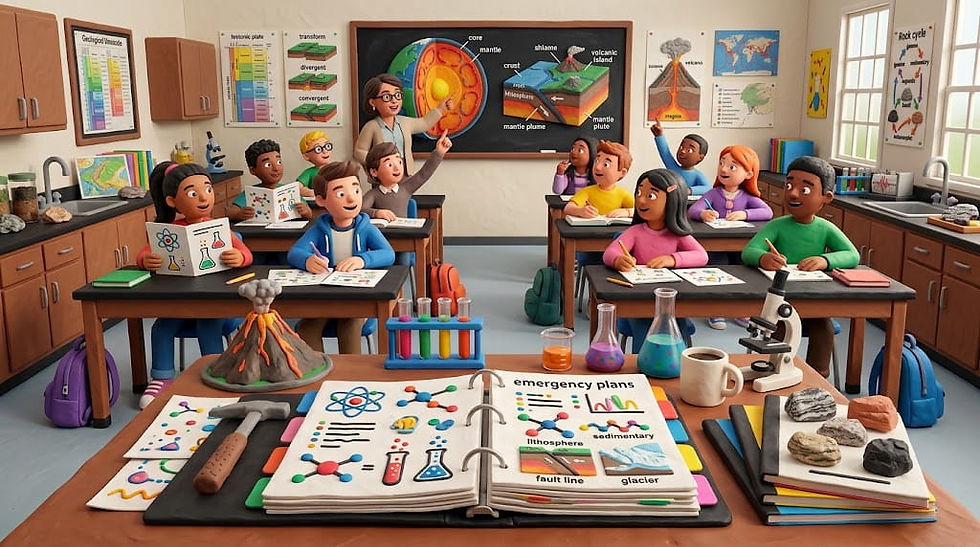
What makes a good emergency Earth science sub plan?
A useful emergency lesson should pass a simple test:
Could a substitute teacher give students the materials and get them started without having to teach the whole Earth science concept first?
That does not mean the lesson should be simplistic. Middle school students can work with quite demanding scientific ideas when the material is well structured.
A strong emergency resource should explain the task clearly, contain enough scientific background for students to begin independently and have an obvious end point. It should also ideally include teacher answers or guidance so that the substitute teacher can tell whether students are on the right track.
Reading passages are particularly useful here because the scientific background is built into the resource. Students can read about tectonic plates, heatwaves, erosion, volcanoes, the atmosphere, oceans or another Earth science topic and then work through questions that make them use what they have read.
The Ultimate 209 Science Reading Comprehension Passages & Questions is one way to build a large grab-and-go bank of material. It currently includes Earth science alongside astronomy, biology, chemistry, physics, medicine and other science topics, with both standard and differentiated reading options across the collection. The product is explicitly designed for substitute teaching, extension, weekly reading and lesson filler.
Why Earth science works well for emergency cover
Some science subjects can be difficult to teach during emergency cover because they depend heavily on specialist equipment.
Earth science has plenty of practical and field-based activities too, but many of its central ideas can also be explored through evidence.
A student can investigate plate tectonics by looking at maps and seismic evidence. They can study hurricanes through weather data. They can investigate erosion through photographs and measurements. They can explore Earth's history through fossils and rock evidence. They can study heatwaves through temperature data and case studies. They can examine ocean pollution using maps, graphs and scientific reports.
That means your emergency lesson can still involve observation, evidence, explanation and reasoning.
This is particularly valuable because Earth science should not become simply a collection of fact-recall activities. Students need to understand processes and relationships. They need to explain why earthquakes occur, how erosion changes landscapes, why extreme weather can develop, how water moves through Earth systems and how human activity can interact with natural processes.
A good emergency resource gives them a structured way to do that.
The 30 to 45 minute quick-cover Earth science lesson
Sometimes you need something that will simply work for one normal lesson.
A very dependable structure is a short reading passage, several comprehension questions and one final scientific thinking task.
The first few minutes can be used to explain the objective and the task. Students then read independently, answer questions and finish with an explanation, prediction or application question.
Tectonic plates are an excellent example.
The free Tectonic Plates Earth Science resource provides a structured route into plate tectonics, and the wider free version includes reading material and questions. Current listings identify it as a free middle school Earth science resource for approximately grades 6 to 9, with the associated research template also available as a free resource.
A quick emergency lesson could ask students to read about plate movement, answer questions about plate boundaries and then finish by explaining why earthquakes and volcanoes are associated with particular types of plate interaction.
The substitute teacher does not need to recreate a tectonics lesson.
The students already have something meaningful to work through.
Do not confuse "no practical" with "no scientific thinking"
This is one of the most important ideas when creating emergency Earth science lessons.
A substitute lesson without equipment should not become a vocabulary worksheet.
Earth science offers plenty of opportunities to analyse evidence without carrying out an experiment.
For example, provide a map showing tectonic plate boundaries and ask students to identify patterns.
Provide a rainfall graph and ask students to explain how precipitation varies.
Provide temperature data from a heatwave and ask students to describe the trend.
Give students before-and-after photographs showing coastal erosion and ask them to identify the evidence of change.
Give them a topographic map and ask what the contours suggest about the landscape.
Give them a set of rock observations and ask students to infer how the rocks may have formed.
These tasks can involve real scientific reasoning even when the normal practical or field investigation cannot happen.
Use data to keep emergency Earth science rigorous
Earth science is particularly suited to data analysis because much of the discipline depends on observations collected over time and across large areas.
Weather is an obvious example.
A middle school class might be given several days of temperature measurements and asked to calculate the change, identify the maximum and minimum, describe a trend and explain what additional data they would want before making a stronger conclusion.
A lesson on earthquakes could provide data on magnitude, depth and location. Students might look for patterns without being expected to become seismologists.
A lesson on ocean science could provide wave height, temperature or pollution data.
A climate-related lesson could provide long-term datasets and ask students what the graph actually shows rather than simply asking them to repeat a claim.
This is a very useful distinction.
Students do not have to collect the data themselves to practise interpreting scientific data.
You can use the emergency lesson to prepare them for the practical or fieldwork that will take place when the regular teacher returns.
A 45 to 60 minute standard emergency Earth science lesson
For a more substantial lesson, combine reading with a scientific processing activity.
A useful sequence is:
Read → understand → organise → analyse → explain.
The reading passage gives students the scientific background.
The questions check that they have understood it.
An anchor chart or graphic organizer helps them organise the ideas.
A map, graph, photograph or dataset gives them something to analyse.
The final task asks them to explain what the evidence means.
Your Science Reading Anchor Charts: Graphic Organizer, Main Idea and Key Details are particularly flexible for this kind of lesson. Although they are not restricted to Earth science, they can be paired with Earth science reading material to help students identify the main idea, select important evidence and organise their understanding.
The important thing is that the organizer has a purpose. Students should be using it to make sense of the Earth science rather than filling in boxes simply because the lesson needs another activity.
For example, after reading about erosion, students could organize the causes, processes and effects of erosion. After reading about the atmosphere, they could connect atmospheric layers with their characteristics. After a tectonics lesson, they could link plate movement, boundary type, geological activity and evidence.
Heatwaves are an excellent emergency Earth science topic
Heatwaves work particularly well because they connect weather, climate, atmospheric processes, environmental systems and human impacts.
They also provide a very natural route from reading into data interpretation and then into research.
The current Heatwaves Earth Science Articles + Research Project Template Set contains two differentiated reading passages plus a structured research project. The accessible passage is aimed approximately at grades 5 to 7, while the more advanced version is aimed at approximately grades 8 to 10. The research task includes a summary, mathematics connection, engineering or technology connection, glossary, inquiry questions and a 20-point rubric, with additional easier and more challenging questions for differentiation.
This makes it particularly useful for emergency teaching.
A shorter lesson could use one reading passage and its questions.
A standard lesson could add an anchor chart or temperature dataset.
A longer lesson could move into the research project.
The class remains focused on one topic, but the level of work can change depending on how much time you have.
Use free Earth science resources to build your emergency folder
You do not need to buy a huge collection before you can start preparing useful Earth science sub plans.
The Free Resources section of The Teaching Astrophysicist is a useful place to start.
Tectonic plates are a particularly strong free option because they work naturally as both a reading lesson and a research activity. There is also a free Tectonic Plates critical-thinking framework available, designed to move students from core ideas such as plate boundaries and convection toward deeper analysis using maps, GPS movement data and case studies.
That illustrates an important principle for emergency planning.
A free resource does not have to mean a lightweight resource.
You can still give students a substantial Earth science lesson without spending money on materials.
Research projects work especially well for longer absences
A research project becomes useful when an absence lasts more than one lesson.
The biggest problem with research for middle school students is usually not a lack of information. It is a lack of structure.
"Research earthquakes" is vague.
A structured template is different. Students know what they need to produce, which concepts they should explore and what a finished task looks like.
Your Earth science research projects follow this sort of approach. A student can be asked to write a short summary, make a mathematics connection, make an engineering or technology connection, define important vocabulary and answer inquiry questions.
That creates a much clearer path for independent work.
The Rock & Earth bundle is a useful example of how broad this can become. The current collection includes topics such as Earth history, tectonic plates, erosion and deposition, mining and ore, crystals, volcanoes, dinosaur fossils, hydrogeology, soil formation and stalactites and stalagmites. The accompanying research templates are designed for independent work, scientific literacy and substitute teaching.
This kind of collection can be particularly useful for a substitute folder because you can give students one topic rather than asking them all to research the same thing.
Volcanoes, earthquakes and natural hazards make strong sub lessons
Natural hazards are particularly useful for emergency Earth science because they give students a scientific problem to investigate.
A volcano lesson can include diagrams, maps, historical evidence and explanations of magma, pressure and eruptions.
An earthquake lesson can use seismic data, maps and case studies.
A tornado or hurricane lesson can use weather maps, storm tracks and atmospheric information.
The students can investigate not only what happens, but why it happens and how people can reduce risk.
This gives you a natural progression from scientific knowledge to application.
A final question might ask:
Why are some communities at greater risk from earthquakes than others?
Or:
What evidence would scientists need to understand the likely impacts of a volcanic eruption?
Or:
Why can two hurricanes with similar wind speeds have very different impacts?
These questions help prevent the lesson from becoming a collection of definitions.
Earth science and human-environment interactions
Earth science also provides many opportunities to connect classroom learning with authentic environmental problems.
Students can investigate pollution, water resources, erosion, extreme weather, oceans, land use, natural hazards or the effects of human activity on Earth systems.
This can make an excellent emergency lesson because the context itself provides a reason to investigate the science.
For example, a lesson on ocean pollution could begin with a reading passage, move to a map or dataset and finish with students explaining which evidence they think is most important when assessing the problem.
A lesson on water resources could ask students to trace where water comes from, how it is stored and what happens when demand exceeds supply.
A lesson on erosion could compare a natural landscape before and after development and ask students to explain what has changed.
The key is to keep the Earth science at the centre rather than allowing the task to become a general discussion about environmental issues.
Use maps and diagrams when fieldwork is not possible
Fieldwork is one of the strengths of Earth science, but it is not always possible during substitute teaching.
Maps can give you a useful alternative.
Students might examine tectonic plate boundaries, river systems, topographic maps, storm tracks, ocean currents, earthquake locations or volcanic distributions.
Diagrams can perform a similar role.
A diagram of the water cycle can become an explanation task.
A cross-section of a volcano can become a labelling and process activity.
A map of an ocean current system can become a prediction task.
A sequence of diagrams showing erosion can be used to identify cause and effect.
This is not the same as taking students outside and making observations, but it still requires students to reason from evidence.
A quick Earth science lesson can become a two-lesson sequence
One of the best ways to prepare emergency cover is to make your resources expandable.
Suppose your class is studying tectonic plates.
Lesson one could use the free reading passage and questions.
If time remains, students could complete an anchor chart showing the relationship between plate movement, plate boundaries, earthquakes and volcanoes.
Lesson two could continue with the research project template or critical-thinking framework.
That means one topic can provide several periods of meaningful learning.
Heatwaves provide the same opportunity. Students can begin with one of the differentiated reading passages, move to a graph showing temperature changes and then continue into the research template if another lesson is required. The current Heatwaves resource was specifically designed to support this sort of flexible use and independent work.
Differentiate without making the substitute teacher do the work
Emergency cover can be particularly difficult in mixed-ability classrooms because the substitute teacher may not know which students need extra support.
Built-in differentiation solves part of this problem.
One straightforward approach is to use two reading levels on the same topic.
Another is to keep the same reading but provide different questions.
A third is to use a research template where some students can work with easier inquiry questions while others tackle more demanding questions.
The Heatwaves set is particularly useful in this respect because it contains two versions of the reading and additional question choices for different levels of support and challenge.
The larger 209-passage science collection also includes 23 topics with accessible and more advanced versions, which gives teachers another way to differentiate without completely changing the lesson.
The substitute teacher therefore has a much simpler job. They are supervising a differentiated lesson rather than having to design the differentiation themselves.
Keep some quantitative thinking in Earth science
Earth science can sometimes be taught as though it is primarily about reading and facts.
It does not have to be.
There is plenty of quantitative thinking in Earth science.
Students can calculate changes in temperature, compare rainfall totals, interpret earthquake magnitude data, examine rates of erosion, work with timelines in Earth's history or analyse numerical information about sea level, storms or water usage.
The calculations do not have to be advanced.
What matters is that students are using numbers to understand a scientific process.
For example, after reading about heatwaves, students might compare the highest temperatures from several years and calculate the difference.
After learning about erosion, they might examine changes in a river channel over time.
After studying earthquakes, they might compare earthquake depths and locations.
After studying Earth's history, they might construct a timeline to understand the enormous timescales involved.
This makes the emergency lesson feel like Earth science rather than general reading practice.
The final ten minutes should ask students to explain
One of the simplest ways to improve any emergency sub plan is to make the ending matter.
Do not let the lesson finish with "complete the worksheet."
Ask students to explain something they now understand.
After tectonic plates:
Why do some plate boundaries produce earthquakes and volcanoes while others do not?
After erosion:
How can moving water change a landscape over time?
After heatwaves:
Why can a heatwave affect both people and ecosystems?
After hurricanes:
Which factors determine how dangerous a hurricane becomes?
After Earth's history:
Why is evidence from rocks and fossils important when reconstructing Earth's past?
The answer could be a paragraph, a labelled diagram, a completed organizer or a Claim-Evidence-Reasoning response.
The point is that students have to use the Earth science.
What about upper elementary Earth science?
Middle school should remain the main audience for your emergency Earth science planning, but the same system can easily be adapted for younger students.
The main difference is the amount of scaffolding.
Upper elementary students can work with topics such as the water cycle, weather, rocks, soils, landforms, earthquakes, volcanoes and the Solar System.
Use shorter reading passages, more visual support and simpler questions.
Instead of giving students a graph with several variables to interpret, you might ask them to identify the warmest and coldest day or describe what happens to water during evaporation.
Instead of asking them to analyse plate boundary evidence, you might have them explain in simple terms why earthquakes happen.
The important principle remains the same: students should learn something meaningful and then use what they have learned.
What about high school Earth science?
At high school level, you can reduce the scaffolding and increase the analytical demands.
Students can work with larger datasets, more complex maps and graphs, scientific uncertainty, competing explanations and longer research tasks.
The same heatwave resource, for example, already includes a more advanced reading level and harder inquiry options that can be used with older or higher-attaining students.
A high school emergency lesson could also involve evaluating evidence from several sources, interpreting a geological cross-section, analysing climate or weather datasets or developing a research response around a natural hazard.
The underlying structure does not need to change.
Read. Organise. Analyse. Explain.
Only the complexity changes.
What should you avoid in an emergency Earth science sub plan?
I would be cautious about leaving a substitute teacher instructions that depend heavily on fieldwork, specialist equipment or a practical procedure they may not know.
"Take the class outside and collect soil samples" may be a perfectly good normal lesson.
It is not necessarily a good emergency lesson.
"Set up a stream-table erosion investigation" can be excellent when you are there to manage it.
It may be far less suitable for unexpected cover.
The same scientific ideas can usually be approached through existing data, photographs, maps, diagrams and reading.
Then, when you return, the practical can become the next stage of learning.
This gives the emergency lesson a useful purpose rather than treating it as a replacement for the original activity.
Build your emergency Earth science folder gradually
You do not need twenty perfect emergency lessons tomorrow.
Start with five.
Choose one natural hazards topic, one Earth materials or geology topic, one weather or atmosphere topic, one environmental topic and one general Earth processes topic.
For each, keep the student material, teacher answers and a short substitute instruction page together.
Make it obvious how long the task should take.
Make the student instructions clear.
Provide something for early finishers.
And keep a printable version available even if you normally teach digitally.
A substitute teacher should not need to ask you what the students are supposed to do next.
The more self-contained the lesson is, the more useful it becomes.
A practical three-level emergency Earth science system
A particularly useful approach is to prepare three versions of your emergency lessons.
Your quick cover lesson takes approximately 30 to 45 minutes. It might be a reading passage, questions and a final scientific explanation.
Your standard cover lesson takes approximately 45 to 60 minutes. Add an anchor chart, map, graph, data task or other analysis activity.
Your extended cover lesson lasts one or several lessons. Move into a research project or longer independent inquiry.
Tectonic plates can work at all three levels.
Heatwaves can work at all three levels.
Volcanoes, erosion, weather, oceans and other Earth science topics can also be built this way.
That is much more practical than creating an entirely separate emergency lesson for every possible situation.
Emergency Earth science lessons should still feel like real Earth science
The point of an emergency sub plan is not simply to keep students occupied until the bell.
It is to make sure that learning continues when the normal lesson cannot.
A student studying tectonic plates is doing Earth science.
A student analysing a heatwave graph is doing Earth science.
A student interpreting evidence about erosion is doing Earth science.
A student investigating volcanoes, Earth's history, the atmosphere or oceans is doing Earth science.
That is why reading passages, anchor charts, data analysis and research projects work so well together.
The reading provides the scientific background.
The questions make students process it.
The organizer helps them structure their understanding.
The map, graph or dataset gives them evidence to interpret.
The research project gives them a longer route into the topic.
The final question asks them to explain what they have learned.
The Teaching Astrophysicist store contains Earth science materials alongside biology, chemistry, physics, space science and health resources, so you can build a broader emergency science library over time rather than having to start from scratch in each subject.
And because the same resources can also be used during ordinary teaching, your emergency folder does not have to become a collection of disposable worksheets.
The free Tectonic Plates resource can become a normal Earth science reading lesson.
The Heatwaves set can support a weather or climate unit.
A research template can become an extension task.
An anchor chart can be used with almost any science article.
A larger collection of reading passages can become a regular science literacy routine.
That is ultimately what makes a good emergency sub plan worth preparing.
It should not feel like a lesson you created because the regular teacher is absent. It should feel like a lesson you would have been happy to teach yourself.
Thanks for reading
Cheers and stay curious
Oliver - The Teaching Astrophysicist


