
Emergency Sub Plans for Middle School Health and Medical Science

Every science teacher eventually needs an emergency sub plan.
Sometimes an absence is planned. Sometimes it is not. A practical lesson cannot go ahead, the normal classroom teacher is suddenly unavailable, or you simply need something that another teacher can pick up with minimal preparation.
Health and medical science can be particularly well suited to this kind of emergency teaching because so many important topics can be explored through reading, diagrams, data, case studies, vocabulary and structured research. Students do not necessarily need specialist equipment to learn about the immune system, the brain, nutrition, human reproduction, disease, genetics or medical technology.
That makes it possible to build a bank of middle school health and medical science emergency sub plans that are academically useful, straightforward for a substitute teacher and flexible enough to work with different classes.
There is also a natural crossover with physical education. PE teachers often encounter anatomy, muscles and joints, exercise, circulation, nutrition, sleep, concussion, injury, fitness and human performance. A well-designed health science emergency lesson can therefore be useful beyond a traditional science department.
The goal is not to replace practical work, discussion or excellent health education. It is to make sure that when the regular lesson cannot happen, students can still spend the period learning meaningful science.
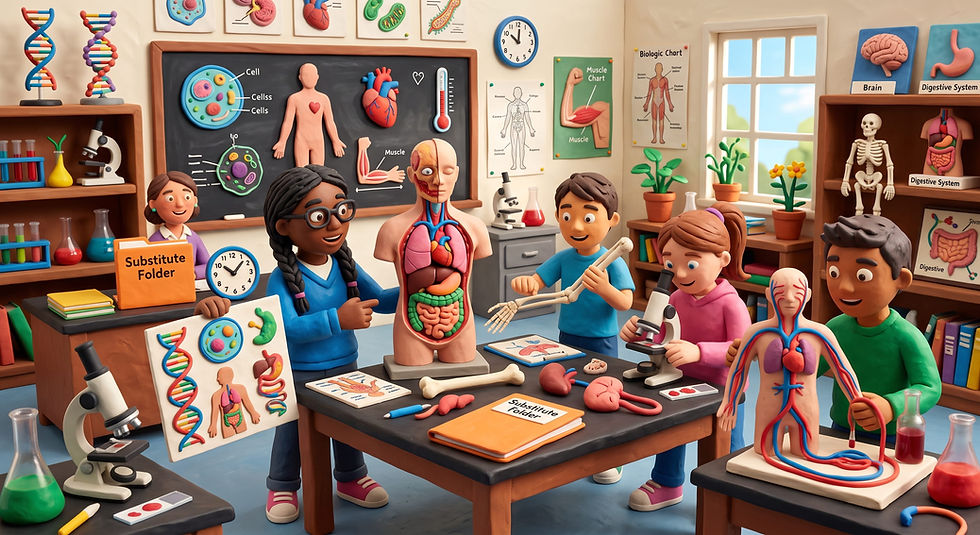
What makes a good emergency health science sub plan?
A useful emergency lesson should pass one simple test:
Could a substitute teacher give students the materials and get them started without having to become the subject expert first?
That does not mean the work should be easy. Middle school students can investigate surprisingly complex medical science when the material is clearly structured.
A strong emergency lesson needs a clear purpose, accessible background information, obvious instructions and a definite end point. It should also ideally include answers, guidance or some kind of assessment so that the substitute teacher can see what students are expected to produce.
Health and medical science is especially suited to reading-based lessons because the vocabulary itself is part of the learning. Students need to understand terms such as immune response, pathogen, inflammation, hormone, circulation, neuron, metabolism and genetic disorder before they can use the concepts properly.
That makes a reading passage plus structured questions a particularly useful emergency lesson format.
The How Do Astronauts Stay Healthy? reading resource is a useful example. It contains two levels of reading about how microgravity affects bones, muscles, circulation and the immune system, with the more accessible version aimed approximately at grades 5 to 7 and the more advanced version at approximately grades 8 to 10. The resource is explicitly designed for substitute teaching, independent work, lesson filler and scientific literacy.
Why health and medicine work particularly well for emergency cover
A health or medical science lesson can often be taught without a laboratory.
Students can learn how the immune system works by examining a diagram.
They can investigate blood pressure by analysing a dataset.
They can study asthma through a structured research task.
They can explore the effects of exercise on the body through graphs and scientific reading.
They can investigate organ donation, human reproduction, nutrition or disease through carefully selected scientific information.
The important distinction is that an emergency lesson should not become a general "health discussion." Keep the science at the centre.
Ask students to explain mechanisms, interpret evidence, use scientific vocabulary and connect cause and effect.
For example, a lesson about asthma could ask students to explain what happens in the airways during an asthma attack and why certain triggers can make symptoms worse.
A lesson about blood pressure could ask students to identify patterns in supplied measurements and explain why multiple measurements may be more useful than one isolated reading.
A lesson about the immune system could ask students to trace what happens when a pathogen enters the body.
Those tasks can be completed without asking a substitute teacher to perform medical demonstrations or manage potentially sensitive classroom activities.
The 30 to 45 minute quick-cover health science lesson
Sometimes you just need one lesson that works.
A very dependable structure is a short science reading passage followed by comprehension and vocabulary questions, with one final question that requires students to explain something in their own words.
The first few minutes can be used to introduce the topic and explain the task. Students then read independently, complete the questions and finish with a short written explanation.
The final question matters.
After learning about the immune system, students might answer:
Why does inflammation occur, and how can it be part of the body's defence?
After learning about the respiratory system:
Why does the body need an efficient exchange of oxygen and carbon dioxide?
After learning about muscles:
Why do muscles need a continuous supply of oxygen and nutrients during prolonged exercise?
After reading about nutrition:
Why does the body need a balance of different nutrients rather than simply as much food as possible?
These are simple enough for independent work, but they require students to use the science.
Scientific literacy is especially important in medical science
Health and medicine contain an enormous amount of specialist vocabulary, which can make independent work difficult for students who are still developing science reading skills.
That is one reason reading passages can be so useful here.
A well-written passage gives students the scientific vocabulary in context instead of presenting a long glossary detached from the underlying idea.
My Health & Medical Science Resources collection uses this approach extensively. The current health and medical science subscription includes reading passages with comprehension questions, vocabulary and CER opportunities, alongside research templates and critical-thinking frameworks. Topics range from blood types and allergies to IV fluids, blood pressure, the immune system, nutrition and other medical science concepts.
This is particularly helpful for emergency cover because the reading itself can carry much of the scientific explanation.
The substitute teacher does not need to spend twenty minutes introducing every term.
The students encounter the vocabulary while learning the topic.
Use the vocabulary as part of the task
Rather than giving students a list of fifteen words to memorise, ask them to use a smaller number of key terms correctly.
For example, a brain lesson might introduce neuron, stimulus, response, synapse and impulse.
A respiratory lesson might focus on alveoli, diffusion, oxygen, carbon dioxide and circulation.
A lesson about immunity might use pathogen, antibody, immune response, antigen and inflammation.
You can ask students to select three terms and use each in a sentence explaining a biological process.
An anchor chart can then take this further by asking students to connect the words rather than simply define them.
Your Science Reading Anchor Charts: Graphic Organizer, Main Idea and Key Details can be paired with almost any health or medical science reading passage. Students can identify the main idea, extract important evidence and organise the relationships between the concepts.
For a medical topic, that might mean turning the reading into a simple process map. Rather than writing "inflammation = swelling," students could show how a trigger leads to a response and what the response is intended to accomplish.
That is much more useful scientifically.
Use diagrams and case studies instead of practical activities
Health science often provides excellent opportunities for diagram-based teaching.
A respiratory system diagram can be annotated.
A heart diagram can be used to trace the movement of blood.
A neuron can be labelled and connected to its function.
A skeletal diagram can be used to explain joints and movement.
A simplified immune-response diagram can become a sequencing task.
Case studies are equally useful.
Give students a short fictional or carefully sourced case and ask them to identify the biological processes involved, interpret the evidence and explain what the evidence suggests.
This is particularly effective for substitute teaching because the case study itself provides the context.
For example, students might receive several pieces of information about a person experiencing asthma symptoms and use what they have learned to explain the biological process.
The task remains educational without requiring students to share personal medical information.
The 45 to 60 minute standard emergency lesson
For a longer lesson, combine reading, processing and application.
A particularly useful sequence is:
Read → understand → organise → analyse → explain.
Students first read the scientific background.
They then answer comprehension and vocabulary questions.
Next, they use an anchor chart or graphic organizer to structure the ideas.
After that, they analyse a small dataset, diagram or case study.
Finally, they write a short explanation.
This structure works for almost every area of health science.
For example, a cardiovascular lesson could involve blood pressure measurements.
A nutrition lesson could use a food-energy dataset.
A neurobiology lesson could include a diagram of a neuron and a sequence showing how signals move.
A respiratory lesson could provide breathing-rate data from different levels of physical activity.
This allows students to do more than read about health. They use evidence to reason about the body.
Keep quantitative thinking in health science
Medical science can sometimes become entirely literacy based, particularly when a substitute teacher is involved.
There is no reason for that.
Middle school health science can include plenty of straightforward quantitative thinking.
Students can compare pulse rates before and after exercise.
They can calculate changes in temperature.
They can compare body-system data.
They can interpret graphs showing breathing rate or heart rate.
They can examine blood pressure values.
They can calculate percentages in a nutrition context.
The mathematics does not need to become an advanced statistics lesson.
The important thing is that students use numbers to interpret biological information.
This works especially well for PE teachers. A lesson about exercise and the cardiovascular system can naturally incorporate heart rate data. A lesson about muscles can use force or movement information. A nutrition activity can use energy values or proportions.
The science and physical education connection therefore becomes very natural.
Asthma makes a strong emergency lesson
Asthma is a useful topic for emergency teaching because students can explore respiratory biology, triggers, gas exchange and health science through reading and research without needing any specialist equipment.
The Asthma Health and Medical Science Research Project Template is explicitly designed as a grab-and-go resource for substitute teaching, extension, scientific literacy and independent work. It includes teacher and student versions and a 20-point rubric.
For a shorter lesson, students could be given the background information and questions.
For a longer lesson, they could complete the research project and investigate the relationship between asthma, the respiratory system, environmental triggers and treatment.
The important thing is to keep the resource educational rather than turning the classroom into a discussion about individual students' experiences with asthma.
Sensitive topics need a little more structure
Health and medicine can involve personal experiences in a way that many other science topics do not.
Students may have family members with asthma, diabetes or cancer. They may have experienced surgery. They may have personal experiences involving mental health, fertility, disability or chronic illness.
A substitute lesson should therefore make it particularly clear that students are not expected to disclose personal medical information.
The focus should be on the scientific topic, not on asking students to tell the class whether they or someone they know has experienced a condition.
You can still have excellent discussion.
The important thing is to discuss the science rather than personal circumstances.
The same applies to research. Encourage students to use reputable scientific and medical sources rather than searching social media or relying on anecdotes.
For an emergency lesson, it is often helpful to provide the relevant information in the resource itself. That gives students a common scientific starting point and reduces the risk of the lesson becoming a collection of conflicting online claims.
Human fertility can become a structured biology and health lesson
Human reproduction and fertility can be challenging topics for emergency cover because the content is sensitive, but they can also provide a very rich scientific learning opportunity when handled carefully.
A structured reading passage can introduce reproductive biology, reproductive health, environmental factors and the scientific questions surrounding fertility without asking students to share anything personal.
My fertility resources provide a useful example. The Human Fertility Crisis Biology Articles + Research Project Template Set combines differentiated reading with a structured research project. The research framework includes a summary, mathematics connection, engineering or technology connection, glossary and inquiry questions, which makes it suitable for independent work rather than requiring a teacher-led discussion.
For sensitive topics like this, the resource structure becomes especially important. Students have a clear academic task to complete rather than being put on the spot to express a personal opinion.
Human reproduction is not the only useful area
A strong emergency health science folder should contain several different types of topics.
Some can be directly connected to human body systems.
Others can focus on disease and medicine.
Others can connect with exercise, nutrition and lifestyle.
Others can investigate medical technology.
That gives you options depending on what students are currently studying.
For example, a class studying the cardiovascular system might work with blood pressure.
A class studying respiration might work with asthma or lung function.
A class studying the nervous system might investigate the brain.
A class studying genetics might investigate hereditary conditions or pedigrees.
A class studying nutrition might examine sugar or energy balance.
A class studying biotechnology might investigate medical technologies or organ transplantation.
The current health and medical science collection includes research templates around subjects such as blood pressure, sugar, the immune system and other topics, alongside reading passages, critical-thinking frameworks and other independent activities.
Research projects are excellent for longer absences
Research projects can work surprisingly well as substitute teaching resources provided that they are structured.
"Research diabetes" is not enough.
Students need to know what they should find out, what they should produce and how the quality of their work will be judged.
That is why your health and medical research project templates can be particularly useful. The asthma project, for example, includes a teacher version, student version and rubric rather than simply giving students a topic and asking them to search the internet.
The Genetic Pedigrees Biology Reading + Research + Worksheets Bundle is another useful model. It combines a scientific reading article with a research framework and worksheets, and the product specifically identifies substitute teaching, research-skills support and scientific literacy as uses.
For a one-day absence, you can use the reading section.
For a longer absence, students can move into the research project.
For a particularly capable class, you can add an independent evidence-analysis task.
A simple 60 minute health science lesson
Imagine you need a lesson for a middle school class studying the human body.
The first five minutes introduce the topic.
Students then spend approximately fifteen to twenty minutes reading a health science article.
The next ten to fifteen minutes are used for comprehension and vocabulary.
Students then spend ten minutes completing an anchor chart or diagram.
The final ten minutes are used for an application question.
That last stage could ask:
Why does the immune system need to distinguish between the body's own cells and foreign material?
Or:
Why does regular exercise affect more than the muscles that are moving?
Or:
Why can a medical condition have effects on several different body systems?
The substitute teacher does not have to invent any of those stages.
The structure is already built into the lesson.
PE teachers can use many of the same resources
The crossover with physical education is worth emphasizing because health and medical science does not belong exclusively to the science classroom.
PE teachers can use reading and research resources to explore the biology behind physical activity.
The cardiovascular system provides obvious connections to heart rate, circulation and oxygen transport.
The respiratory system connects to breathing, gas exchange and exercise.
Muscles and the skeletal system connect to movement, injury and biomechanics.
Nutrition connects to energy use and recovery.
Sleep connects to performance, brain function and health.
Concussion and injury can connect to nervous-system function and anatomy.
A resource such as How Do Astronauts Stay Healthy? is a particularly nice example of this crossover because students investigate bones, muscles, circulation, the immune system, exercise and nutrition in a real-world context.
A PE teacher could use the resource as a literacy task connected to human physiology, while a science teacher could use it as an extension into human body systems.
Free resources are useful when building your emergency folder
You do not need to purchase a huge library before you start.
A sensible approach is to build the folder gradually using a combination of free and paid resources.
The Free Resources section of The Teaching Astrophysicist is a good starting point for this wider library.
There is also a useful broader collection of free science reading material on the Teaching Astrophysicist website, including biology and life science topics that can be adapted for independent learning.
For health and medicine specifically, it is also worth thinking in terms of reusable formats rather than only individual topics. A single good anchor chart can accompany many readings. A research template can be reused with different questions. A strong scientific literacy routine can work for several units.
That keeps your emergency folder from becoming a random collection of worksheets.
Choose topics that a substitute teacher can manage comfortably
Health and medicine has another advantage for emergency cover: you can avoid activities that require medical equipment or specialist supervision.
There is no need for a substitute teacher to demonstrate injections, handle medical equipment or run an elaborate physiology practical.
Instead, students can interpret heart-rate data, analyse a diagram of the circulatory system, study a case about asthma, investigate how a treatment works or compare the functions of different body systems.
This is particularly important with sensitive subjects.
The emergency lesson should have enough structure that students know what they are doing, but not so much open-ended discussion that the substitute teacher has to manage a difficult conversation about personal health.
A good rule is:
Give students science to investigate, not personal experiences to disclose.
The final ten minutes should ask students to use the science
Just as with other emergency science lessons, the final part of the lesson should not simply be "finish the worksheet."
Give students something to explain.
After a lesson about asthma:
Why can narrowing of the airways make breathing more difficult?
After learning about blood pressure:
Why might scientists and doctors care about repeated measurements rather than a single reading?
After studying the brain:
Why do different regions of the nervous system need to communicate effectively?
After learning about exercise:
Why does physical activity affect several body systems at the same time?
After studying human reproduction:
Why is fertility influenced by several biological factors rather than a single process?
These questions are manageable for independent work but still require students to think.
Keep the science separate from medical advice
For classroom materials dealing with real diseases, treatments or medical conditions, it is worth being especially careful about the distinction between learning about medicine and giving medical advice.
Students should be learning how a biological process works, how a treatment is designed, what researchers have discovered or how a disease affects the body.
They should not be expected to diagnose themselves or classmates.
An emergency lesson should also avoid framing the classroom as a place to make personal medical decisions.
That keeps the lesson firmly within science education.
It also makes the substitute teacher's role much clearer.
Upper elementary health and life science
The same emergency-sub approach can work in upper elementary, but with more visual support and simpler language.
Topics such as nutrition, the human skeleton, teeth, the five senses, exercise, muscles, sleep and basic body systems can be particularly accessible.
A short reading passage could introduce how the heart pumps blood, followed by a simple diagram that students label and a final question asking why the heart needs to beat continuously.
A nutrition lesson could introduce the major nutrient groups and ask students to identify why the body needs a range of nutrients.
The emphasis should be on accessible explanations and structured tasks rather than large amounts of medical terminology.
High school health and medical science
At high school level, you can reduce the scaffolding and increase the analytical demand.
Students can compare evidence from different sources, interpret more complex datasets, investigate medical technologies or evaluate the evidence behind a scientific claim.
The same research templates can also become more independent.
Instead of a tightly guided paragraph, students might be expected to synthesise several pieces of evidence, discuss limitations and construct a reasoned conclusion.
The current health and medical science collection is specifically designed for both middle and high school teachers and includes reading passages, research projects and critical-thinking frameworks intended to support scientific literacy and reasoning.
Build your emergency health science folder gradually
You do not need dozens of lessons.
Start with a few dependable ones.
Choose one body-system topic, one disease or medical condition, one nutrition or exercise topic, one genetics or reproduction topic and one medical technology topic.
Keep the student materials, teacher answers and substitute instructions together.
Make it obvious how long the task should take.
Provide a clear early-finisher activity.
Keep a printable version available even if you normally use digital materials.
Then add to the folder as you go.
The beauty of this approach is that the resources can still be used when nobody is absent.
A reading passage can introduce a topic.
A research project can extend a topic.
An anchor chart can support a practical.
A medical case study can become a homework task.
A critical-thinking framework can become a review lesson.
You are building a general teaching library, with emergency cover as one of its uses.
A three-level emergency health science system
A very practical system is to think of your emergency lessons in three levels.
Your quick cover lesson takes about 30 to 45 minutes. Use a reading passage, questions and a final explanation.
Your standard cover lesson takes approximately 45 to 60 minutes. Add an anchor chart, diagram, case study or simple dataset.
Your extended cover lesson lasts one or several lessons. Move students into a structured research project.
A topic such as asthma can work across all three levels.
A body-system topic can work across all three.
A genetics topic can work across all three.
Human fertility can work across all three, provided the material is appropriately structured and sensitive.
That gives you flexibility when the timetable changes or an absence unexpectedly becomes longer than one day.
Health and medical science should still feel like science
The purpose of an emergency sub plan is not simply to keep students busy.
Students should still be learning.
A student tracing the movement of blood through the body is doing science.
A student analysing heart-rate data is doing science.
A student explaining how asthma affects the respiratory system is doing science.
A student investigating how a medical technology works is doing science.
A student researching genetics, immunity or human reproduction is doing science.
That is why the combination of reading passages, vocabulary, anchor charts, case studies, data and research projects works so well for emergency health and medical science teaching.
The reading gives students the scientific background.
The questions help them process it.
The organizer helps them structure the ideas.
The case study or dataset provides something to analyse.
The research project gives them a longer route into the topic.
The final question asks them to explain what they have learned.
The Health / Medical Science resources are built around this mixture of formats, including reading passages, research project templates, critical-thinking frameworks, vocabulary-rich activities, games and other independent-learning materials.
And because these resources can also be used during ordinary teaching, you are not creating a folder full of disposable emergency worksheets.
You are building a library that can support science literacy, health science, biology, physical education and independent learning throughout the year.
That is ultimately what makes a good emergency sub plan worth preparing.
It should not feel like a lesson created because the regular teacher is absent. It should feel like a lesson you would have been happy to teach yourself.
Thanks for reading
Cheers and stay curious
Oliver - The Teaching Astrophysicist


