
How to Teach Difficult Science Concepts to Struggling Readers: Practical Strategies for Upper Elementary, Middle School and High School Science

Some of the hardest moments in science teaching happen when you know your students are capable of understanding a concept, but the reading gets in the way.
A student may understand photosynthesis when you explain it aloud but struggle to understand a textbook paragraph about chloroplasts. Another may be able to discuss gravity but freeze when asked to read a page about forces and acceleration. A student might understand the basic idea of climate change but become lost when a science article introduces unfamiliar vocabulary, statistics, graphs, and multiple linked concepts on the same page.
This creates an important distinction for science teachers:
Sometimes a student is struggling with the science. Sometimes they are struggling to access the science through reading.
Those are not quite the same problem.
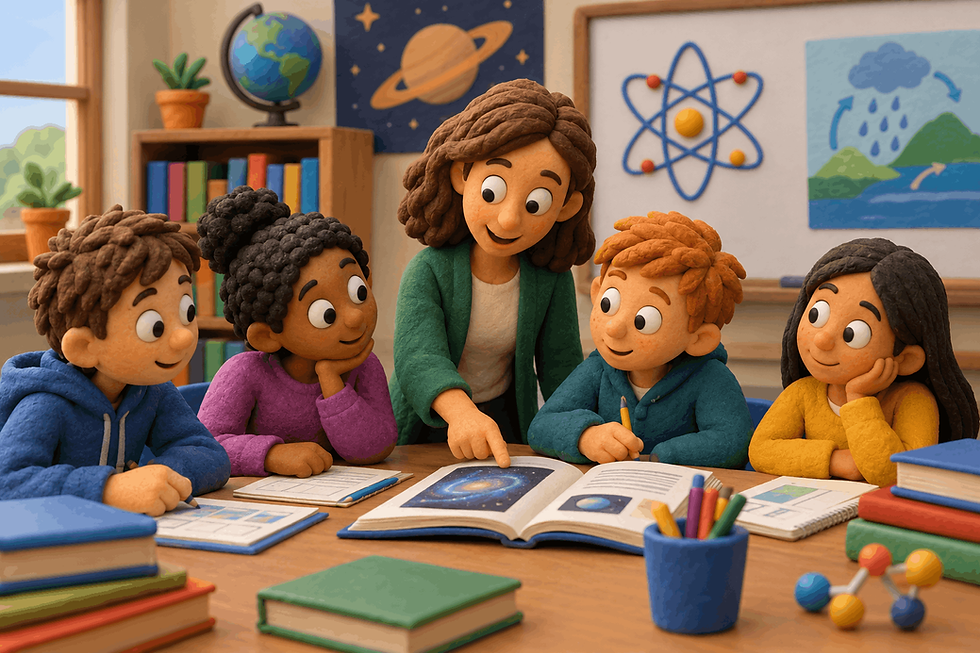
Helping struggling readers in science does not mean removing the interesting or challenging science. In many cases, the better approach is to keep the underlying concept worthwhile while reducing unnecessary barriers to accessing it.
That might mean using shorter sections of text, explicitly teaching a few important vocabulary terms, providing a graphic organizer, reading aloud before asking students to read independently, asking fewer but better questions, or allowing students to demonstrate understanding in a different way.
The aim is not to make science easier.
The aim is to make difficult science understandable.
Why difficult science concepts become difficult science reading
Science has its own language.
Students encounter technical vocabulary, unfamiliar processes, diagrams, mathematical relationships, abstract concepts, passive sentence structures, cause-and-effect explanations, and information that assumes prior knowledge.
Consider a sentence such as:
Increasing atmospheric carbon dioxide can alter Earth's radiative balance, contributing to changes in global temperature.
A student may understand each individual word and still struggle to understand the sentence.
That is why simply telling students to "read it again" is not always enough.
A struggling science reader may need help answering questions such as:
What is this paragraph actually about?
Which words matter?
What happened first?
What causes what?
Which information is evidence?
What do I need to remember?
What does this diagram show?
How does this connect with what I already know?
These are science reading skills as much as they are literacy skills.
The practical question for the teacher is therefore not simply, "How do I give this student an easier text?"
It is: "What support will help this student access the important science without lowering the intellectual value of the lesson?"
1. Start with the science concept, not the reading level
One of the most useful mindset shifts is to identify the non-negotiable scientific understanding first.
Suppose you are teaching ecosystems.
You might decide that students need to understand:
Energy enters most ecosystems through producers and is transferred between organisms through feeding relationships.
Once that is clear, you can vary the reading experience without losing the essential science.
A student who needs substantial support might work with a short passage containing carefully selected vocabulary and a structured graphic organizer.
Another student might read a longer passage and answer questions requiring explanation.
A more advanced student might examine a second source and evaluate the evidence.
All three students can still be working toward the same central scientific idea.
This is often much more productive than automatically assigning struggling readers a much simpler topic.
2. Break difficult science reading into smaller chunks
One of the simplest strategies is also one of the most effective:
Do not make students process everything at once.
Instead of handing students a long article and saying, "Read this and answer the questions," divide the task.
Read two paragraphs.
Stop.
Discuss one important idea.
Identify one vocabulary word.
Ask one question.
Continue.
A science passage about the human immune system, for example, might be divided into sections on pathogens, the first line of defense, immune responses, and memory cells.
After each section, students could complete one small task.
This is particularly valuable for upper elementary and younger middle school students, but it can also help older students when the scientific content becomes especially dense.
The purpose is not to make the lesson slower for everyone.
It is to reduce the amount of information students have to hold in working memory at one time.
3. Pre-teach only the vocabulary that really matters
Science teachers can easily fall into the trap of giving students a huge vocabulary list.
That may actually make a difficult reading task feel even more difficult.
Instead, identify the small number of words without which the science itself becomes difficult to understand.
For a lesson on cells, those might include:
membrane
nucleus
cytoplasm
organelle
You can then do something useful with those words before reading.
Ask students to predict their meanings.
Show a picture.
Give a simple definition.
Ask for an everyday connection.
Use the word in a sentence.
Have students draw it.
The important point is that vocabulary should become a tool for understanding the science, rather than another list students are expected to memorize.
A structured focus-word activity can be particularly useful here. The Science Reading Anchor Charts resource includes a routine that asks students to investigate a key scientific term through its definition, synonyms, real-world examples, and symbols or sketches. Science Reading Anchor Charts | Graphic Organizer Main Idea and Key Details.
4. Give students a purpose for reading
"Read this passage" is a surprisingly vague instruction.
Struggling readers especially benefit from knowing what they are looking for.
Instead try:
Find three pieces of evidence that explain why the population changed.
Or:
Identify the three stages in this process.
Or:
Find one cause, one effect, and one example.
Or:
Find one scientific term that is essential to understanding the article.
Now the student has a destination.
This also makes it easier for you to differentiate.
One student may be looking for three key facts.
Another may identify evidence supporting a claim.
A more advanced student might evaluate whether the evidence actually supports that claim.
The reading can stay broadly similar while the thinking becomes different.
5. Use graphic organizers to make invisible thinking visible
A common problem for struggling readers is that the teacher asks for a complex thinking process without explicitly showing what that process looks like.
"Summarize the article."
"Explain the evidence."
"Compare these concepts."
"Describe the process."
These sound straightforward to an experienced reader.
They are not always straightforward to a student who is still learning how to read scientific information.
A graphic organizer can turn an abstract instruction into a sequence of visible steps.
For example:
Read → identify key idea → find evidence → explain connection
or:
Vocabulary → definition → example → visual
or:
Topic 1 → similarities → Topic 2
or:
Problem → possible cause → evidence → solution
The 25 Science Reading Anchor Charts collection is designed around these types of repeatable thinking structures. It includes routines for vocabulary, comparison, visual analysis, questioning, experimental design, data, evidence verification, summarizing, and making connections.
This is useful because the organizer can change the process of reading without changing the scientific goal.
That makes it a practical differentiation tool rather than simply another worksheet.
6. How to help struggling readers in upper elementary science
Upper elementary students can have very different reading abilities even within the same class.
One student may already read science nonfiction confidently.
Another may struggle to decode unfamiliar vocabulary.
Another may read fluently but find it difficult to decide which details matter.
For this age group, I would focus heavily on structure, visuals, discussion, and manageable chunks.
Use short sections
A relatively short science passage can be split into several stopping points.
After each section, ask students to record one important idea.
Pair reading with speaking
Allow students to discuss what they think the text means before asking them to write.
"Tell your partner what you think this paragraph is saying" can be much more accessible than immediately asking for a written explanation.
Make vocabulary physical and visual
Draw it.
Point to it.
Act it out.
Match the word to an image.
Use an object when possible.
This is particularly useful for concrete science such as forces, materials, body systems, habitats, weather, and Earth science.
Let students draw their understanding
A student may struggle to write a paragraph explaining the water cycle but produce an excellent diagram showing evaporation, condensation, and precipitation.
A drawing should not always be treated as a less rigorous response.
The real question is:
Does the drawing accurately communicate the science?
The "Draw It Up" routine in the anchor chart collection specifically asks students to create a visual or diagram showing a key concept from their reading.
Use partner discussion strategically
A student who struggles with reading independently may have excellent scientific reasoning once the information has been discussed.
Reading aloud, partner reading, and teacher questioning can provide access to the same underlying science.
7. How to help struggling readers in middle school science
Middle school is often where science reading becomes noticeably more demanding.
Students encounter longer texts, more specialized terminology, more abstract ideas, and more expectations around explaining evidence.
This is a good time to start teaching students how to read science deliberately.
Instead of expecting them to "just improve their reading," teach them reusable routines.
Before reading
Ask:
What do you already know?
What do you think this text will be about?
Which words might be important?
What question do you want the text to answer?
The "Words, Questions & Don't Know" anchor chart is especially useful because students record their predictions before reading and then revisit them afterward, identifying new vocabulary, questions, and remaining uncertainties.
During reading
Ask students to stop at planned points.
Have them identify:
one key idea
one important vocabulary term
one piece of evidence
or
one thing they do not understand
This gives you much more useful information than discovering at the end of a 40-minute lesson that a student understood almost nothing.
After reading
Give students a structured thinking task.
They might compare concepts, construct a diagram, connect the topic with real life, develop a hypothesis, or identify a question for further investigation.
8. How to help struggling readers in high school science
High school science can be especially challenging because the reading burden increases at exactly the same time as the science becomes more abstract.
Students may be expected to understand texts about genetics, electromagnetism, chemical equilibrium, evolution, climate science, astronomy, or cellular respiration while also processing graphs, formulas, diagrams, and specialized vocabulary.
For struggling readers, the solution should not automatically be to give them "easy science."
Instead, provide structured access to demanding ideas.
For example, after reading a passage about genetics:
A supported student might identify key vocabulary and the main scientific idea.
Another student might explain the relationship between genes, DNA, and proteins.
A more advanced student might evaluate evidence or research an unresolved question.
The content is related.
The cognitive demand changes.
9. Read science passages aloud without removing independent reading
Reading aloud can be particularly useful when the science is conceptually important but the text itself is demanding.
The teacher can read the first section aloud while modeling thinking:
"This sentence introduces a new vocabulary word."
"This evidence supports the claim we discussed earlier."
"This paragraph explains a cause-and-effect relationship."
You are not simply reading the text for them.
You are demonstrating how a science reader thinks.
After that modeling, students can read the next section independently or with support.
Over time, the goal should be greater independence.
10. Use dual-level science reading passages when appropriate
Sometimes the most straightforward differentiation is to provide two versions of a science reading passage covering the same core topic.
This can be particularly useful when students have genuinely different reading demands.
A useful pair might include:
Accessible version: shorter sentences, more manageable vocabulary, clearer structure and strong support for extracting the main scientific ideas.
More advanced version: greater complexity, denser explanation, more sophisticated vocabulary, or more demanding questions.
The advantage is that students can study the same topic and still participate in a common class discussion.
This is an approach I use in a number of my science reading resources.
For example, the "How Do Astronauts Stay Healthy?" resource includes two reading passages with questions, one more accessible and one more advanced. The accessible version is aimed approximately at grades 5–7 and the more advanced version approximately at grades 8–10, while the same broad scientific topic remains at the centre.
The larger Teaching Astrophysicist science reading collection uses the same general idea in numerous places, including paired reading passages specifically intended to support differentiation. Science Reading Passages and Questions
This approach is particularly useful when you want differentiation to feel normal rather than remedial.
11. Do not make struggling readers answer 20 questions
More questions do not necessarily mean more learning.
A student who is already finding a passage difficult may become exhausted by a long sequence of comprehension questions.
Instead, choose a smaller number of high-value questions.
For example:
What is the central idea?
What evidence supports it?
Why does it matter?
Those three questions may generate considerably more useful thinking than fifteen questions focused mostly on finding isolated facts.
You can also differentiate the number of questions.
One student completes three carefully selected questions.
Another completes five.
Another completes the core three and then moves into a deeper task.
That is differentiation without unnecessary workload.
12. Use "I see, I think, I wonder" with science visuals
Struggling readers can sometimes access science more successfully through visual information than through a dense paragraph.
Use that.
Give students a diagram, photograph, graph, model, or scientific illustration and ask:
What do you see?
What do you think it means?
What do you wonder?
The important part is encouraging students to distinguish between observation and interpretation.
The corresponding anchor chart routine in the collection specifically encourages students to examine visuals from the text before responding.
This can work beautifully in biology, physics, Earth science, chemistry, and astronomy.
13. Turn difficult reading into a research question
A struggling reader does not have to remain at the comprehension stage forever.
Once students understand the basic science, encourage them to move outward.
Ask:
What would you like to know more about?
What question does this reading make you wonder about?
What related topic could you investigate?
This can be an excellent bridge from reading into research.
A structured research template can help students who are not yet ready to plan a research project from a blank page.
Instead of:
"Research this topic."
students might work through a sequence such as:
Summarize the idea.
Identify key vocabulary.
Find a mathematical or technological connection.
Develop questions.
Investigate a related idea.
This kind of scaffold is particularly useful in middle and high school.
The Teaching Astrophysicist store includes science research project templates alongside science reading resources, allowing teachers to move students from guided reading into more independent scientific inquiry. Science research and project resources.
14. Use an anchor chart as a bridge to independence
One of the best long-term uses of a science reading anchor chart is to gradually make it less necessary.
At first, you may model the routine.
Then complete it together.
Then let students work in pairs.
Then let students use the chart independently.
Eventually, students may not need the printed organizer at all.
For example, you might teach the sequence:
Key idea → evidence → explanation
repeatedly.
After several weeks, students should begin using that structure in their own written responses.
The organizer has done its job.
It has become a mental routine.
This is why reusable science reading structures are often more valuable than a one-off worksheet designed for one particular article.
15. Differentiate the output rather than always changing the reading
Another practical option is to keep the reading broadly consistent and change what students have to do with it.
After a passage about plate tectonics:
One student could identify the main idea.
Another could explain the evidence for plate movement.
Another could draw the process.
Another could compare two types of plate boundaries.
Another could design a simple investigation or model.
Another could research a real earthquake or volcanic event.
This approach can be particularly useful when classroom discussion and shared content matter to you.
Everyone is still talking about plate tectonics.
They are simply demonstrating their learning at different levels.
16. Connect science reading to familiar contexts
Difficult concepts become easier to access when students can connect them to something they already understand.
A text about pressure becomes more accessible when connected to bicycle tires.
A text about heat transfer can begin with cooking.
A text about forces can connect to cycling, sports, or vehicles.
A text about chemical reactions can connect to food, cleaning, or everyday materials.
A text about astronomy can connect to the night sky.
The "Real Life?" routine in the anchor chart collection specifically asks students to identify how the science connects to things in everyday environments such as the kitchen, bathroom, or outdoors.
The question is simple:
Where does this science exist outside the classroom?
That question can unlock understanding.
17. Give students a way to say "I don't know yet"
Struggling readers can sometimes hide confusion because they believe they are expected to have an answer.
Give them a legitimate alternative.
Ask:
What do you still not understand?
Which word is still confusing?
What question do you still have?
What would you need to know to answer this confidently?
This does two things.
It helps the teacher identify misconceptions and it teaches students that uncertainty is a normal part of learning science.
The Words, Questions & Don't Know routine is designed around this before-and-after reflection, giving students space to identify what they knew, what they learned, and what remains unresolved.
18. Teach students to verify science claims
This becomes especially important in middle and high school.
Students may encounter scientific claims online that sound convincing but are incorrect, exaggerated, outdated, or unsupported.
A useful reading task is therefore:
What does the text claim?
What evidence does it give?
Can you verify the claim elsewhere?
How trustworthy is your source?
The Factual Truth anchor chart in the science reading collection asks students to identify facts from the text, verify them using sources outside the text, and consider the trustworthiness of those sources.
That is a considerably richer activity than simply asking students to find information on Google.
It also prepares students for the reality that science literacy increasingly involves judging information, not merely finding it.
A practical three-level approach for difficult science concepts
When a class contains a wide range of reading abilities, it can help to think of a lesson in three broad layers.
Level 1: Access
Students need to understand the essential science.
Use:
shorter sections
vocabulary support
teacher modeling
partner discussion
visuals
structured graphic organizers
focused questions
Level 2: Explain
Students are ready to demonstrate deeper understanding.
Use:
evidence-based responses
comparisons
process diagrams
cause-and-effect explanations
data interpretation
real-world connections
Level 3: Extend
Students are ready to move beyond the immediate text.
Use:
experimental design
research questions
source verification
evaluation of evidence
independent research
mathematical or engineering connections
The important thing is that these levels do not necessarily represent permanent "ability groups."
A student might need Level 1 support for a difficult genetics text but be perfectly capable of Level 3 thinking when discussing a familiar topic.
That is why flexible differentiation tends to be more useful than labeling students permanently.
A complete example: teaching a difficult concept about black holes
Imagine you are teaching black holes to a mixed-ability middle or high school science class.
The concept is inherently challenging.
There are unfamiliar terms.
There are abstract ideas.
There is considerable prior knowledge involved.
You could begin with a short science reading passage.
Before reading:
What do you already know about black holes?
What words do you predict will appear?
What question would you like the article to answer?
During reading:
Students identify one key vocabulary term and one important idea.
After reading, differentiate the task.
A student needing more support might:
Define event horizon and explain it in simple language.
Another student might:
Explain why light cannot escape from inside the event horizon.
A more advanced student might:
Explain how the evidence used by astronomers allows us to infer the presence of a black hole.
Then give students a choice.
They could:
draw a diagram
compare black holes with neutron stars
investigate a real black hole observation
develop a research question
connect the concept to gravity and spacetime
You have not created three completely separate units.
You have created different routes through the same science.
How TTA science reading resources can make this easier
Differentiating science reading well takes thought, but it does not have to mean creating every scaffold from scratch.
A practical classroom resource library can give you reusable pieces that you combine according to the needs of the lesson.
The Teaching Astrophysicist's science reading resources are designed as ready-to-use materials for exactly this kind of work, including reading passages with questions, paired passages for differentiation, graphic organizers, and research activities.
The larger collection currently includes more than 200 science reading passages across astronomy, biology, chemistry, physics, Earth science, medicine and health, and related science topics. It also includes a number of paired passages with an accessible and more advanced version, specifically giving teachers another way to differentiate reading while keeping students focused on the same broad scientific topic. Explore the full science reading passage collection - 209 Science Reading Comprehension Passages & Questions.
The Science Reading Anchor Charts collection can then provide the thinking structure around the reading. Rather than asking every student to complete identical comprehension questions, you can select an appropriate routine such as Focus Word, Venn It, Factual Truth, Experimental Design, Question Refinement, Draw It Up, or Connected Foundations. See the 25 Science Reading Anchor Charts - Science Reading Anchor Charts | Graphic Organizer Main Idea and Key Details.
Then, when students are ready to move beyond comprehension, research project templates can provide another layer of structure.
That creates a useful progression:
Read → Understand → Organize → Question → Research → Communicate
It also means you can reuse the same overall framework across biology, chemistry, physics, Earth science, health science, and astronomy.
The goal is not to make difficult science "easy"
This is perhaps the most important idea to take away.
Struggling readers do not need to be protected from challenging science.
They need access to it.
A student can struggle with reading and still think deeply about a scientific problem.
A student can need vocabulary support and still understand a sophisticated concept.
A student can need a graphic organizer and still produce excellent scientific reasoning.
The job of differentiation is therefore not to lower the ceiling.
It is to remove unnecessary barriers to reaching the ceiling.
For upper elementary students, that might mean short sections, visual explanations, partner discussion, drawings, and vocabulary support.
For middle school students, it might mean explicit reading routines, structured questions, graphic organizers, and flexible text complexity.
For high school students, it might mean source evaluation, evidence analysis, research, data interpretation, and more independent scientific reasoning.
And across all three age groups, one principle remains useful:
Keep the science meaningful. Change the support.
That approach makes it possible to help struggling readers become better science readers without making science less interesting.
The best differentiation often does not look like three completely different lessons.
It looks like one worthwhile scientific idea, with several thoughtful ways for students to get there.
Thanks for reading
Cheers and stay curious
Oliver - The Teaching Astrophysicist


