
November 30 in Science History: Mark Twain, Jagadish Chandra Bose and a Meteorite That Hit a Woman

November 30 offers three very different ways to bring science into the classroom. A famous writer was born during the appearance of Halley’s Comet and later died shortly after its next return. An Indian scientist demonstrated wireless transmission of electromagnetic waves before turning his attention to how plants respond to their environment. And in 1954, a space rock crashed through a house in Alabama and struck a woman who was taking a nap. Together, these stories connect astronomy, physics, biology and the importance of investigating unusual events.
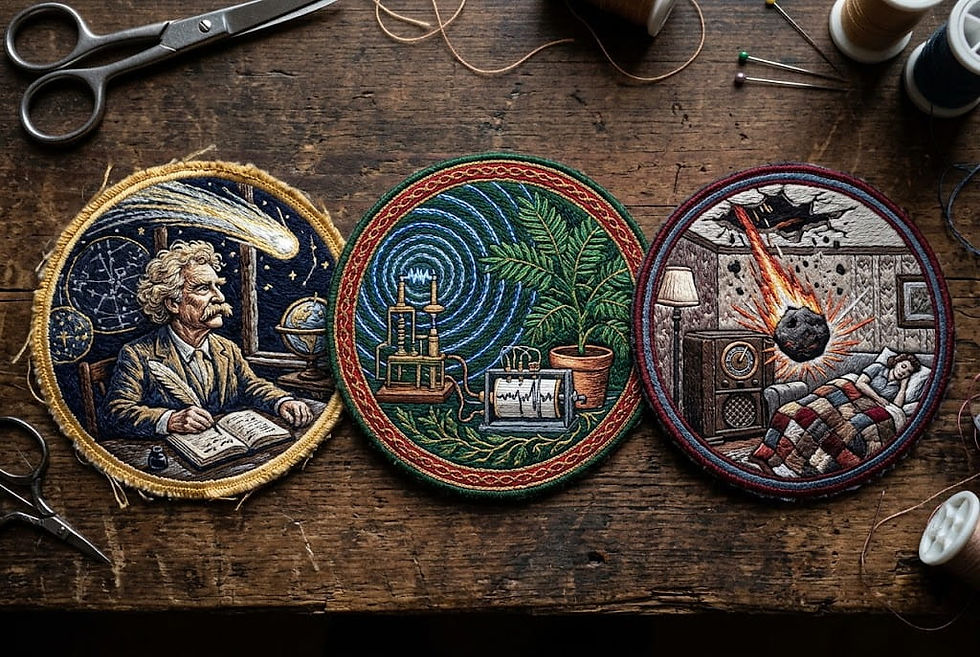
1835: Mark Twain is born as Halley’s Comet returns
Samuel Langhorne Clemens, better known by his pen name Mark Twain, was born on November 30, 1835, in Florida, Missouri. His birth coincided with the appearance of Halley’s Comet, one of the most recognisable objects in the night sky. The comet’s return had been predicted using the mathematics of orbital motion, making it an excellent example of how scientific models can help us anticipate events in nature.
Halley’s Comet is a periodic comet, meaning it travels around the Sun and returns to the inner Solar System at regular intervals. Its orbit takes roughly 76 years, although the exact interval varies because the gravity of planets changes its path slightly. As the comet approaches the Sun, heat causes frozen material on its surface to release gas and dust. This material forms the glowing cloud around its nucleus and the tail that can make the comet so striking in the sky.
Before English astronomer Edmond Halley studied the comet’s path, many people believed that comets appeared only once. In the early 1700s, Halley compared observations of comets seen in 1531, 1607 and 1682. He concluded that these were appearances of the same object and predicted that it would return. The comet reappeared in 1758, after his death, supporting his prediction and showing the power of Newtonian physics to explain the motion of objects in space.
Twain knew about the coincidence between his birth and the comet’s appearance. He later predicted that he would leave the world with the comet, too. He died on April 21, 1910, the day after Halley’s Comet reached its closest point to the Sun during that return. The dates make a memorable story, but they are not evidence of a special connection between a person’s life and a comet. The comet was not at its closest point to Earth on the exact days of Twain’s birth and death.
Classroom connection: Ask students why scientists can predict the return of a comet but cannot use the same methods to predict the details of an individual person’s life. This opens a discussion about mathematical models, evidence, probability and the difference between a coincidence and a causal relationship. Students can also sketch a simplified elliptical orbit and explain why a comet’s distance from the Sun changes over time.
1858: Jagadish Chandra Bose connects physics and plant biology
Jagadish Chandra Bose was born on November 30, 1858, in what is now Bangladesh. He became an influential physicist and biologist whose research crossed the boundaries between disciplines. His early work investigated electromagnetic waves, including radio waves and microwaves, and he later developed sensitive instruments to measure how plants respond to stimuli.
In 1895, Bose demonstrated the wireless transmission and reception of microwave signals in Calcutta, now Kolkata. His experiments showed that electromagnetic waves could carry signals without a wire connecting the transmitter and receiver. This work came before many of the best-known demonstrations of wireless communication, although the development of radio involved multiple researchers working on different parts of the problem.
Bose also investigated how electromagnetic waves behaved when they encountered different materials. His experimental equipment included detectors made from materials that responded to the waves, helping advance understanding of how electromagnetic radiation could be detected. His work is a useful reminder that scientific technologies often develop through contributions from people whose names are less familiar than those most often associated with an invention.
Later, Bose shifted much of his attention to plants. He investigated how plants responded to physical stimuli and built instruments, including a device called the crescograph, capable of recording very small changes in plant growth. Plants do not have brains or nervous systems like animals, but they can respond to light, gravity, touch, temperature and other environmental conditions. Measuring these responses can be difficult because some changes happen slowly or are too small to see easily.
Bose’s work provides a useful bridge between physics and biology. The same broad scientific habits appear in both: designing instruments, controlling conditions, making measurements, looking for patterns and testing explanations against evidence. His career also offers a chance to discuss the barriers researchers can face. Despite his achievements, Bose experienced racial discrimination and unequal treatment during his academic career under British colonial rule.
Classroom connection: Ask students to compare a radio-wave detector with an instrument that measures plant growth. What does each device detect, and how does it make something otherwise difficult to observe measurable? A simple investigation could involve tracking a seedling’s growth over several days, keeping light and water as consistent as possible. Students can discuss measurement uncertainty and why repeated observations are more useful than a single measurement.
1954: Ann Hodges is struck by a meteorite
On November 30, 1954, Ann Hodges was resting on a sofa in her home near Sylacauga, Alabama, when a rock fell through the roof, bounced off a radio and struck her hip, leaving a severe bruise. The object was identified as a meteorite, a piece of natural material from space that survived its passage through Earth’s atmosphere and reached the ground.
The meteorite weighed about 3.6 kilograms. It had travelled through space before entering the atmosphere, where friction with the air and compression of the air ahead of it caused intense heating. Many smaller space rocks break apart or burn up during atmospheric entry, but some fragments survive and land on Earth. These recovered fragments give scientists physical material that can be examined in laboratories.
The Hodges incident became one of the best-documented cases of a person being injured by a meteorite. It was an extraordinary event, but it is important to distinguish between the rock’s journey through space and its final impact with the house. The meteorite was not aiming at a person. It followed a physical trajectory, and the unfortunate coincidence of its landing place brought it into contact with Ann Hodges.
The event also highlights the difference between a meteoroid, a meteor and a meteorite. A meteoroid is a small rocky or metallic body travelling through space. A meteor is the streak of light produced when such an object enters an atmosphere and heats the surrounding gas. A meteorite is material that survives the journey and reaches the ground. These terms describe different stages or aspects of the same process, and they are often mixed up in everyday conversation.
Meteorites can help scientists investigate the early Solar System. Many formed from material left over when the planets were developing billions of years ago. By studying their minerals and chemical composition, researchers can learn about the conditions under which these objects formed. A meteorite that lands on Earth is therefore not simply an unusual rock: it can be a sample of material from beyond our planet.
Classroom connection: Invite students to explain why most incoming space rocks do not reach the ground intact. They could compare the three terms, then draw a labelled diagram of a small rocky object entering Earth’s atmosphere. For an evidence-based extension, ask what observations and tests scientists might use to distinguish a meteorite from an ordinary Earth rock.
Using Science on This Day in your classroom
These three events can work as short lesson starters, discussion prompts or introductions to larger topics. Mark Twain’s connection with Halley’s Comet gives students a way to explore orbits and scientific prediction. Bose’s work shows how the same experimental skills can be used in physics and biology. Ann Hodges’s experience offers an unusual entry point into the Solar System, atmospheric entry and the evidence used to identify space rocks.
For ready-to-use daily science history activities, my November Science on This Day resource includes 109 STEM stories across the month in several formats: an interactive HTML version with subject and date filters, classroom display mode and discussion questions; editable slides; a filterable spreadsheet; and a printable PDF. You can use a story as a quick retrieval prompt, ask students to respond to the discussion question, or let them choose an event to investigate further.
If you would like to explore the wider collection, visit The Teaching Astrophysicist store for additional science activities, reading resources and classroom materials. There are also free resources available, so you can try out different approaches without needing to build every activity from scratch.
Looking ahead: the end of November and the start of December
November’s final days offer more opportunities to connect science with people, discoveries and real-world problems. November 28 marks the founding of the Royal Society in 1660, a useful starting point for discussing scientific communities and how researchers share evidence. November 29 features Christian Doppler, whose name is associated with the Doppler effect, as well as the 1929 expedition flight that reached the South Pole. These events can lead into lessons about waves, motion, exploration and the technology needed to work in challenging environments.
As December begins, the daily stories continue across physics, astronomy, engineering, biology and other STEM subjects. My December Science on This Day resource includes 132 items across all 31 days of the month, again available in interactive HTML, slides, spreadsheet and PDF formats. It can help you keep science history in your routine through the final weeks of the year, whether you need a two-minute starter or a discussion that leads into a full lesson.
Science history is especially useful when it shows students that science is not just a collection of facts to memorise. It is a process of observing, measuring, questioning and revising explanations. On November 30, that process appears in the mathematics of a returning comet, the experiments of a physicist and biologist, and the analysis of a rock that travelled from space to someone’s living room.
Thanks for reading
Cheers and stay curious
Oliver - The Teaching Astrophysicist


