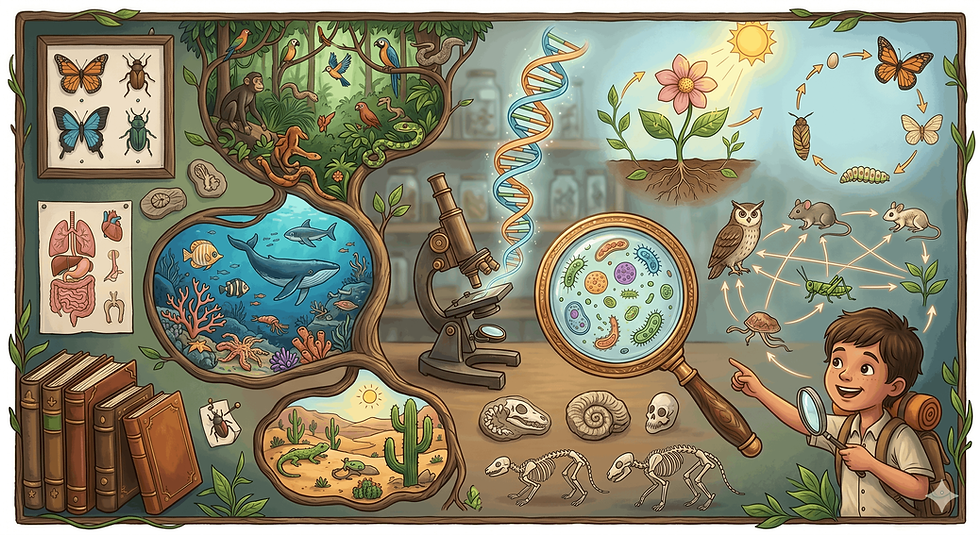
Biology Vocabulary Words for Middle School Students: The Ultimate Science Spelling and Vocabulary Guide

Biology is the study of life, and it introduces students to an incredible range of topics including cells, genetics, ecosystems, evolution, microorganisms, and the human body. As students move into middle school, biology becomes more sophisticated, and understanding scientific vocabulary becomes increasingly important.
Strong biology vocabulary helps students read scientific texts with confidence, communicate ideas effectively, and build the foundation needed for high school science.
Whether students are studying cells under a microscope or learning about food webs and heredity, mastering scientific language is essential for scientific literacy.
This guide provides a comprehensive list of biology vocabulary words for middle school students, along with practical strategies for teaching vocabulary through reading and discussion.

Why Biology Vocabulary Matters
Scientific literacy depends on language.
Students who develop strong biology vocabulary can:
Read science texts more effectively.
Improve reading comprehension.
Understand complex concepts.
Participate in scientific discussions.
Write evidence-based explanations.
Prepare for high school biology.
Develop critical thinking skills.
Repeated exposure to scientific terminology through reading and writing helps students move beyond memorization toward true understanding.
Essential Cell Biology Vocabulary
Cells form the foundation of biology and introduce students to many important scientific terms.
Cell Structure Vocabulary
Cell
Nucleus
Cytoplasm
Cell Membrane
Cell Wall
Vacuole
Chloroplast
Mitochondria
Ribosome
Organelle
Tissue
Organ
Organ System
Organism
Microscopy Vocabulary
Microscope
Magnification
Lens
Specimen
Slide
Resolution
Observation
Structure
Function
Genetics and Heredity Vocabulary
Middle school students are often fascinated by why living things inherit characteristics.
Genetics Vocabulary
DNA
Gene
Chromosome
Trait
Heredity
Inheritance
Dominant
Recessive
Mutation
Variation
Allele
Punnett Square
Offspring
Parent
Genotype
Phenotype
These terms lay the groundwork for future genetics studies.
Ecology Vocabulary
Ecology connects living organisms with their environment.
Ecosystem Vocabulary
Ecosystem
Habitat
Niche
Population
Community
Species
Biodiversity
Producer
Consumer
Decomposer
Predator
Prey
Symbiosis
Competition
Adaptation
Extinction
Food Web Vocabulary
Food Chain
Food Web
Herbivore
Carnivore
Omnivore
Energy Pyramid
Trophic Level
Photosynthesis
Cellular Respiration
Human Body Vocabulary
Middle school biology frequently focuses on body systems.
Human Anatomy Vocabulary
Skeletal System
Muscular System
Circulatory System
Respiratory System
Digestive System
Nervous System
Endocrine System
Immune System
Reproductive System
Organ
Tissue
Cell
Neuron
Blood Vessel
Artery
Vein
Capillary
Microbiology Vocabulary
Students often enjoy learning about microscopic organisms.
Microorganism Vocabulary
Bacteria
Virus
Fungus
Protozoa
Parasite
Pathogen
Infection
Disease
Antibiotic
Vaccine
Immunity
Microorganism
Plant Biology Vocabulary
Plants provide an excellent opportunity to connect biology with ecology.
Plant Science Vocabulary
Photosynthesis
Chlorophyll
Stomata
Root
Stem
Leaf
Flower
Seed
Fruit
Pollination
Germination
Xylem
Phloem
Evolution Vocabulary
Middle school students are often introduced to evolution and natural selection.
Evolution Vocabulary
Evolution
Natural Selection
Adaptation
Fossil
Extinction
Species
Variation
Mutation
Survival
Ancestor
Trait
Challenging Biology Vocabulary for Advanced Middle School Students
Students ready for greater challenge may encounter:
Homeostasis
Diffusion
Osmosis
Cellular Respiration
ATP
Enzyme
Fermentation
Mitosis
Meiosis
Ecosystem Dynamics
Symbiosis
Mutation
Biodiversity
Taxonomy
Classification
Archaea
Protist
Autotroph
Heterotroph
Biotechnology
These words help bridge middle school and high school biology.
Commonly Misspelled Biology Words
Many biology terms contain complex spelling patterns.
Provide additional support for:
Photosynthesis
Cellular Respiration
Mitochondria
Chromosome
Biodiversity
Microorganism
Photosynthesis
Germination
Chlorophyll
Symbiosis
Adaptation
Mutation
Classification
Circulatory
Respiratory
Repeated reading and writing help students internalize these words.
The Best Way to Teach Biology Vocabulary
Vocabulary is most effectively learned through meaningful contexts rather than isolated word lists.
Science Reading Passages
Reading informational texts allows students to encounter scientific vocabulary naturally.
Students may learn:
"Photosynthesis" while reading about plants.
"Mutation" while studying genetics.
"Symbiosis" through ecosystem examples.
"Mitochondria" while exploring cells.
Context transforms difficult words into meaningful concepts.
Vocabulary Journals
Students can:
Define terms.
Draw diagrams.
Write examples.
Make connections.
Create illustrations.
Discussion and Speaking
Using scientific language during discussions strengthens confidence and understanding.
Scientific Writing
Having students explain processes encourages active use of vocabulary.
Word Walls
Visual references help students retain terminology throughout a unit.
Using Reading Passages to Build Biology Vocabulary
One of the most effective ways to improve scientific vocabulary is through engaging science reading passages.
Reading passages simultaneously develop:
Scientific literacy
Reading comprehension
Academic vocabulary
Critical thinking
Background knowledge
Writing skills
Teachers looking for ready-to-use science literacy materials can explore the extensive collection of science reading passages available through The Teaching Astrophysicist Store:
These resources cover hundreds of fascinating biology topics including cells, genetics, microorganisms, ecosystems, evolution, anatomy, plants, and animals. Students naturally encounter scientific vocabulary while improving comprehension and critical thinking skills.
Additional classroom resources are available at:
Many educators find that combining vocabulary instruction with science reading passages provides an engaging and efficient way to strengthen both literacy and biology understanding.
A Weekly Biology Vocabulary Routine
Monday
Introduce 5–10 biology vocabulary words.
Tuesday
Read a biology-focused science passage containing the target terms.
Wednesday
Complete comprehension activities and discussions.
Thursday
Apply vocabulary through investigations and diagrams.
Friday
Use scientific terms in writing assignments or quizzes.
Consistent exposure helps students transform unfamiliar terms into lasting understanding.
Final Thoughts
Biology vocabulary gives middle school students the language needed to understand life itself.
By combining vocabulary instruction with reading, writing, discussion, and hands-on investigations, teachers can help students become stronger readers, better communicators, and more scientifically literate learners.
Whether students are studying cells, genetics, ecosystems, evolution, or human anatomy, a strong biology vocabulary foundation supports academic success and prepares students for high school science and beyond.
Thanks for reading
Cheers and stay curious
Oliver - The Teaching Astrophysicist