
Biology Vocabulary Words for Upper Elementary Students: The Essential Science Spelling and Word List

Science is often described as a language of its own. Students who develop strong biology vocabulary early find it easier to read scientific texts, understand classroom discussions, write detailed explanations, and build confidence when tackling more advanced science topics later in middle and high school.
One of the biggest barriers to science success is not always understanding the concepts themselves. Often, it is understanding the words used to describe those concepts.
That is why building biology spelling and vocabulary knowledge in upper elementary classrooms is so important.
Whether students are learning about animals, plants, ecosystems, cells, habitats, or the human body, a strong vocabulary foundation helps them become better readers, better writers, and better scientific thinkers.
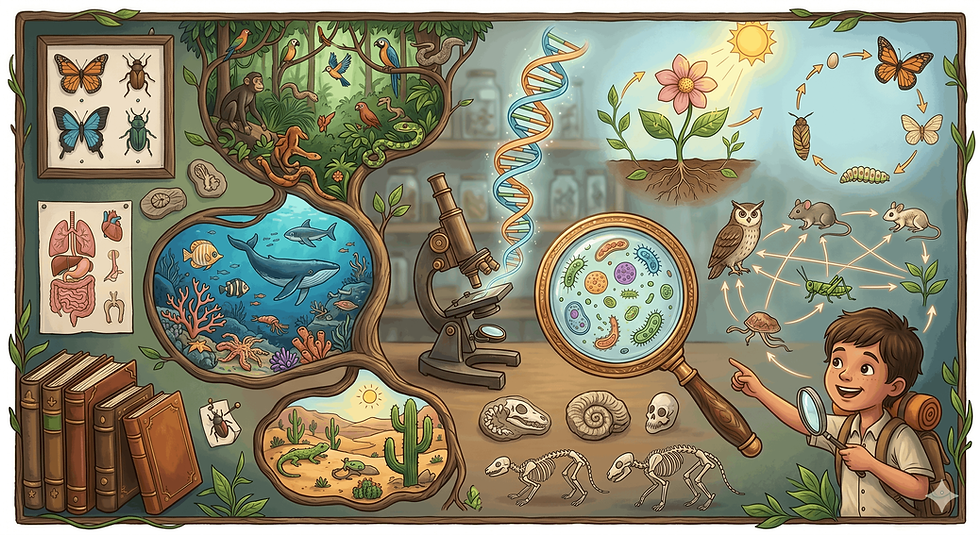
Why Biology Vocabulary Matters
When students encounter unfamiliar science words, they often focus so much energy on decoding the vocabulary that they miss the scientific meaning.
Students with stronger biology vocabulary can:
Read science texts more fluently
Understand scientific explanations more easily
Write higher-quality responses
Participate confidently in discussions
Develop stronger scientific literacy
Prepare for future middle school and high school science courses
Research and classroom experience consistently show that vocabulary knowledge is closely linked to reading comprehension and academic success across all subject areas.
Essential Biology Vocabulary List for Upper Elementary Students
Living Things
Organism
Living
Non-living
Biology
Species
Population
Community
Habitat
Ecosystem
Environment
Adaptation
Survival
Predator
Prey
Competition
Extinction
Biodiversity
Animal Vocabulary
Mammal
Bird
Reptile
Amphibian
Fish
Insect
Vertebrate
Invertebrate
Skeleton
Fur
Feathers
Scales
Migration
Hibernation
Camouflage
Nocturnal
Diurnal
Plant Vocabulary
Plant
Root
Stem
Leaf
Flower
Seed
Fruit
Pollen
Germination
Photosynthesis
Chlorophyll
Nutrient
Water
Growth
Reproduction
Pollination
Dispersal
Human Body Vocabulary
Body
Organ
Tissue
Cell
Brain
Heart
Lungs
Stomach
Intestine
Muscle
Bone
Skeleton
Blood
Circulation
Digestion
Respiration
Nervous System
Cell Biology Vocabulary
Cell
Nucleus
Membrane
Cytoplasm
Microscope
Magnification
Structure
Function
Bacteria
Microorganism
Virus
Unicellular
Multicellular
Ecosystems and Environmental Science Vocabulary
Food Chain
Food Web
Producer
Consumer
Decomposer
Herbivore
Carnivore
Omnivore
Energy
Conservation
Pollution
Recycling
Renewable
Natural Resource
Climate
Weather
Life Cycles Vocabulary
Egg
Larva
Pupa
Adult
Metamorphosis
Growth
Development
Reproduction
Offspring
Life Cycle
Challenging Biology Words for High-Achieving Upper Elementary Students
For students who need additional challenge, consider introducing these more advanced terms:
Cellular Respiration
Adaptation
Classification
Biodiversity
Ecosystem
Pollination
Germination
Photosynthesis
Vertebrate
Invertebrate
Microorganism
Evolution
Conservation
Symbiosis
Mutation
Genetics
Inheritance
Biodiversity
Endangered
Extinction
These words help bridge the gap between elementary science and the vocabulary students will encounter in later grades.
Effective Ways to Teach Biology Vocabulary
Simply providing a list of words is rarely enough. Students learn scientific vocabulary best when words are encountered repeatedly in meaningful contexts.
Some highly effective strategies include:
Reading Science Articles
Science reading passages expose students to vocabulary naturally within real scientific explanations.
Students see how terms such as "habitat," "adaptation," "photosynthesis," and "ecosystem" are used in authentic contexts rather than isolated word lists.
This contextual learning often produces deeper understanding and stronger retention than memorization alone.
Vocabulary Journals
Encourage students to:
Write definitions
Draw diagrams
Create examples
Use words in sentences
Connect new vocabulary to prior learning
Word Walls
A biology word wall can become a powerful classroom reference point throughout the year.
Science Discussions
Regular opportunities to speak scientific vocabulary help students become comfortable using academic language.
Reading Comprehension Activities
Combining vocabulary instruction with reading comprehension creates powerful opportunities for literacy and science learning to reinforce one another.
Using Reading Passages to Build Biology Vocabulary
One of the most effective ways to teach biology vocabulary is through high-interest science reading passages.
Reading passages allow students to encounter scientific terminology within engaging contexts while simultaneously strengthening reading comprehension and scientific literacy skills.
This approach is particularly valuable because students learn:
Vocabulary
Reading skills
Scientific concepts
Critical thinking
Written communication
all at the same time.
If you are looking for ready-to-use science literacy resources, the collection of science reading passages available through The Teaching Astrophysicist Store offers hundreds of engaging science texts covering biology, chemistry, physics, earth science, health science, and space science topics. The extensive library includes more than 200 science reading passages that help students build both scientific knowledge and academic vocabulary.
Teachers can explore the full collection of reading resources here:
Many educators find that regular use of science reading passages helps students become more confident readers while simultaneously strengthening their scientific vocabulary and content knowledge. Science literacy routines built around reading passages can support vocabulary development, comprehension, discussion, and evidence-based writing.
A Weekly Biology Vocabulary Routine
A simple routine might look like this:
Monday: Introduce 5-10 new biology words.
Tuesday: Read a science passage containing the vocabulary.
Wednesday: Complete comprehension questions.
Thursday: Discuss vocabulary in groups.
Friday: Apply the words in writing or a short project.
Over time, this repeated exposure creates lasting vocabulary growth while reinforcing science content.
Final Thoughts
Biology vocabulary is much more than a spelling exercise. It provides students with the language needed to understand the living world around them.
By regularly exposing upper elementary students to meaningful scientific vocabulary through reading, discussion, writing, and investigation, teachers can build strong foundations for future science success.
Whether students are learning about plants, animals, ecosystems, cells, or the human body, a rich biology vocabulary helps transform curiosity into understanding and understanding into scientific literacy.
Thanks for reading
Cheers and stay curious
Oliver - The Teaching Astrophysicist


