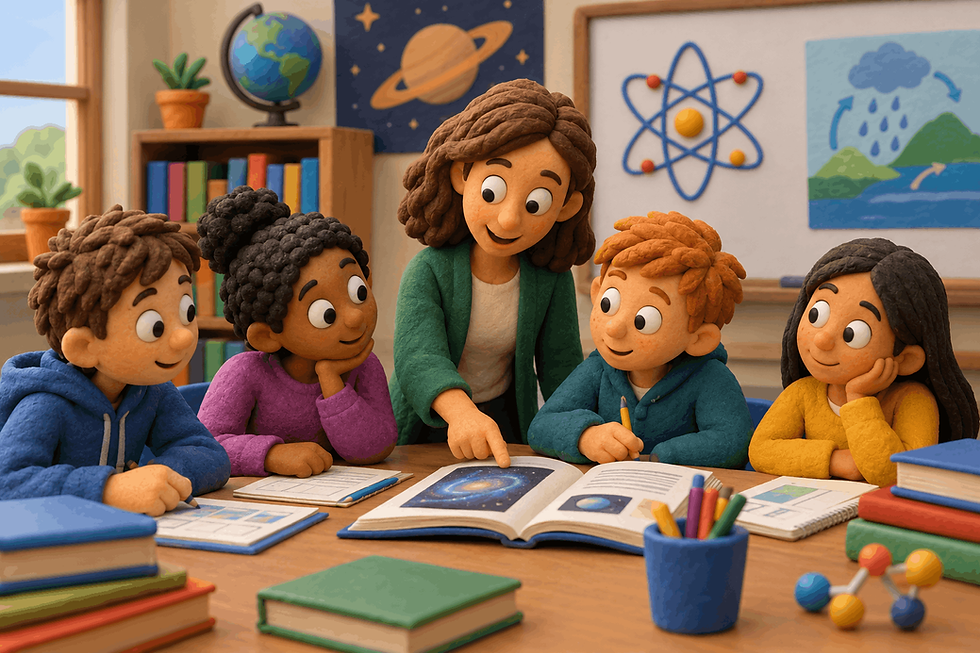
Science Still Needs Wonder: Why Play, Curiosity and Awe Matter in Middle and High School Science

There is something I have believed for a very long time about teaching science.
Science should still be fun.
Not necessarily “fun” in the sense that every lesson needs a game, a competition, a practical experiment or students running around the classroom. I mean something slightly deeper than that.
Science should give students a sense of wonder.
It should occasionally make them stop and think, “Wait. Really?”
It should make them curious enough to ask another question.
It should make them look at something ordinary, such as a piece of metal, a sneeze, a puddle, a battery or a cup of coffee, and suddenly realise that there is an extraordinary amount of science hiding inside it.
And I increasingly think this matters even more now that we are teaching in the age of artificial intelligence.
Science has a wonder problem
Over the last few years, AI has become a growing part of education.
We have students using it to answer questions, produce writing, summarise information, generate images, explain difficult concepts and, sometimes, avoid thinking altogether. We are still working out exactly what education should look like when a machine can produce something that looks like competent student work in a few seconds.
There are very serious questions here about assessment, knowledge, literacy, critical thinking and what students actually need to learn.
But there is another question that I think deserves more attention:
What makes learning science worth doing in the first place?
For me, part of the answer is wonder.
A machine can generate a paragraph explaining a black hole.
It can summarise the life cycle of a massive star.
It can give you ten facts about the mantis shrimp.
It can explain how photosynthesis works.
It can probably produce a reasonably convincing explanation of why the sky is blue before I have finished typing the question.
But that does not mean students no longer need teachers.
Quite the opposite.
Students still need someone to say:
“Look at this.”
“Have you ever thought about what is actually happening here?”
“Isn't that strange?”
“Why do you think nature works like this?”
“What would happen if we changed this?”
“How on Earth did scientists figure that out?”
That human invitation to be curious is still enormously valuable.
The world is already full of incredible science
We do not need to invent wonder.
It is already everywhere.

Take the mantis shrimp. It is an animal that seems almost absurdly over-engineered, with an extremely sophisticated visual system and a strikingly powerful appendage used to strike prey.
Or the African lungfish, an animal capable of surviving periods of drought by entering a dormant state and breathing air.
Or the barn owl, whose adaptations for hunting include extraordinary hearing and specialised feather structures that help reduce the noise created by flight.
Then there are the physical phenomena.

Lightning.
Ball lightning, which remains an unusual and not fully understood phenomenon.
Methane bubbles trapped beneath lake ice.
The strange behaviour of water as it freezes.
Flames, plasma, magnetism, superconductivity, auroras and the sheer weirdness of quantum mechanics.
And then there is astronomy.
I still find it difficult to teach astronomy without occasionally stopping and thinking just how ridiculous the universe is.

We are living on a planet around one ordinary star in one galaxy among an enormous number of galaxies.
We can detect planets orbiting other stars.
We can study the atmospheres of some of those planets.
We can investigate objects so dense that even light cannot escape them.
We can look backwards in time by observing distant galaxies because light takes time to travel.
We can ask whether life exists somewhere else.
NASA's current exoplanet resources note that scientists have confirmed more than 6,000 exoplanets, with many more candidates still awaiting confirmation. We still have no confirmed evidence of life beyond Earth. That combination of discovery and uncertainty is exactly the sort of thing that can generate an excellent classroom conversation.
And perhaps that is the point.
Science gives us an almost endless supply of questions that we do not fully know the answer to.
That is a gift.
Primary school often gets this right
One thing I have noticed over the years is that primary school teachers often seem much more comfortable with this idea of science.
Young children are naturally interested in the world.
Everything is new.
A strange animal, a rock, a magnet, a shadow or a volcano can be enough to trigger a stream of questions.
Why?
How?
What happens if...?
Could we...?
What would happen if we did it upside down?
There is often less fear of simply enjoying the subject.
As students move into middle school and high school, that can start to disappear.
The mathematics becomes more demanding.
The vocabulary becomes more specialised.
The content becomes more abstract.
There are equations to learn, diagrams to interpret, practical skills to master and assessments to prepare for.
All of those things matter.
But sometimes, somewhere along the way, science can start looking like a subject that is mainly about remembering information and successfully manipulating mathematical relationships.
That is a shame.
Because the mathematics is describing something.
The equation represents something happening in the real world.
The chemical reaction is doing something.
The diagram represents a structure.
The graph tells us something about nature.
The formula is not the destination. It is one of the tools we use to understand what is happening.
We should not lose the wonder when the mathematics arrives
I love mathematics in science.
I also understand that some students see an equation appear on the board and immediately think that the fun has ended.
I think one of our jobs as science teachers is to connect the equation back to something worth understanding.
Take electricity.
You could teach students about static electricity, charge, potential difference and current.
You could give them equations.
You could have them complete calculations.
You could assess whether they understand the units.
All of that is useful.
But you could also ask:
Did you know lightning is an enormous electrical discharge?
Suddenly the subject feels a little different.
Or take chemistry.
We can teach atomic structure, the mole, relative atomic mass and chemical calculations.
But there is something wonderfully strange about asking a student:
How many atoms are in your body?
That question opens the door to atomic mass, the mole, Avogadro's constant, estimation and scale.
The mathematics has not gone away.
The mathematics has become meaningful.
Or take biology.
Rather than simply teaching cellular respiration, ask students to think about the fact that the oxygen they are using right now is helping release energy from the food they ate.
Rather than simply teaching enzymes, ask how the human body manages to perform incredibly complicated chemical reactions at temperatures compatible with life.
Rather than simply teaching genetics, ask why siblings are not genetically identical in the way copies of a digital file are.
The curriculum is still there.
The lens changes.
Sometimes the best science is hiding in ordinary things
I think we sometimes have a tendency to believe that “exciting science” has to mean dinosaurs, rockets, black holes or erupting volcanoes.
Those subjects are wonderful hooks. I use them myself.
But there is another kind of wonder that I think is just as powerful.
The science of ordinary life.
For example, copper has antimicrobial properties. Copper and copper alloys have been extensively studied for their ability to kill or inhibit microorganisms when they come into contact with the material, although the real-world impact on infection rates in healthcare settings is more complicated than the simple statement “copper kills bacteria.”
That is a brilliant starting point for chemistry and biology.
Why does copper do that?
What happens at the molecular level?
What are copper ions doing?
Why might a hospital be interested in antimicrobial surfaces?
What are the advantages and limitations?
Suddenly an everyday metal becomes a gateway into materials science, microbiology, chemistry and healthcare.
Or consider the technology around us.
A car tyre is an astonishing piece of engineering when you stop and think about it.
It has to cope with friction, heat, deformation, water, wear, load and changing road conditions.
A coffee machine combines thermodynamics, fluid mechanics, materials science, electrical engineering and human-centred design.
Velcro is another lovely example. Something that looks simple actually opens up questions about biomimicry, materials, manufacturing, design and engineering. I have a classroom reading resource based around how Velcro is made for exactly this kind of reason.
Even the humble sneeze is worth a conversation.
Why do we sneeze?
What is the body actually trying to accomplish?
Why does it happen so violently?
Why do some people sneeze in response to bright light?
These are not “lesser” science topics.
They are science.
And for some students, they may be a much more accessible way into the subject than beginning with an abstract diagram.
The little wonders can sometimes be the biggest hooks
One of my favourite things about science teaching is finding something that makes students unexpectedly interested.
Perhaps it is an animal with an unusual adaptation.
Perhaps it is a strange medical condition.
Perhaps it is a material they have never considered before.
Perhaps it is a question they never realised science could answer.
I am fortunate to work in an alternative online school environment where I have been able to explore topics such as the development and future of rockets, male sterilisation and the possible implications of changing fertility patterns, financial mathematics, and the science behind everyday body functions such as sneezing, hiccups and vomiting.
I realise that not every school has the freedom to build a curriculum in exactly this way.
Most of us have specifications to follow.
We have content requirements.
We have assessments.
We have limited lesson time.
But I do think there is usually some room to choose the route into the content.
You might have to teach acids and bases.
That does not mean the lesson has to begin with a definition.
You might begin with the question:
Why can some animals survive in environments that would be incredibly dangerous for us?
You might have to teach electricity.
Could you start with:
How much electricity would it take to run your house for a year?
You might have to teach forces.
Could you begin with:
Why does a Formula 1 car need aerodynamics that deliberately push it down towards the track?
You might have to teach waves.
Could you start with:
How does your phone turn somebody speaking into a signal that can cross the world?
The curriculum remains.
The doorway changes.
Wonder is also a way of protecting student curiosity from AI
This is where I think the AI conversation becomes particularly interesting.
I do not think the answer to AI in education is to pretend it does not exist.
Nor do I think the answer is simply to ban it.
AI is going to be part of students' lives.
Instead, I think we need to be increasingly deliberate about creating learning experiences where students have a reason to think for themselves.
Wonder helps with this.
A student who is genuinely curious about something is much more likely to ask a follow-up question.
They are more likely to challenge an answer.
They are more likely to notice something that does not make sense.
They are more likely to say, “That cannot be right.”
And that matters enormously when AI is involved.
One of the most useful things we can teach students is that an answer is not necessarily the same thing as an understanding.
AI can provide an answer.
Science education should help students develop the habits to interrogate that answer.
Is it plausible?
What evidence supports it?
What assumptions are being made?
Could the explanation be wrong?
What experiment could test it?
What would I expect to observe?
What does this result actually tell me?
Curiosity is not an optional extra here.
It is part of the defence against passive acceptance.
Reading can be one of the simplest ways to bring wonder back
Not every lesson needs a spectacular practical.
Not every teacher has access to a laboratory full of equipment.
Not every school can regularly visit museums, observatories or science centres.
Sometimes a really good piece of science reading is enough to begin.
I have become increasingly fond of the idea of a regular science reading habit, particularly with middle and high school students.
A short article about an unusual animal.
A strange physical phenomenon.
A new medical development.
An engineering problem.
A discovery in space.
A material used in everyday technology.
A scientific mystery.
Then a few questions.
What did you learn?
What surprised you?
What do you think?
What would you like to investigate further?
That is one reason I have built such a large collection of science reading passages and questions in my own resource library. My larger collection now brings together hundreds of topics across biology, chemistry, physics, Earth science, health and space science, with the aim of giving teachers interesting, ready-to-use science topics that can sit alongside the main curriculum.
For example, something like my Voyager 1 and 2 reading resource can turn space exploration, planetary science, communication and the search for life into a short literacy-based science activity, while offering differentiated reading levels.
You do not have to make it the whole lesson.
It can simply be the spark.
Visuals can help students organise the wonder
I also think there is a place for visual organisation.
A student can read something astonishing and then forget most of it.
A good anchor chart, graphic organiser or visual summary can help turn those interesting facts into connected knowledge.
For example, after learning about an unusual biological adaptation, students could organise their thinking around:
Structure → Function → Survival advantage → Environment → Evidence
For a space topic:
Object → What we observe → How we know → What it means → What we still do not know
For a material:
Properties → Structure → Manufacturing → Uses → Limitations
This is one reason I particularly like science anchor charts and graphic organisers. They give students a way to hold onto the ideas rather than simply consuming another interesting fact.
I have a Science Reading Anchor Charts: Graphic Organizer, Main Idea and Key Details resource designed around this very purpose. It can be used to help students identify the main idea and organise the important information they encounter in science reading. Science Reading Anchor Charts resource.
Wonder can lead to research
There is also a natural progression from:
“That's interesting.”
to
“I want to know more.”
That is where research projects become useful.
Perhaps students become interested in how telescopes find exoplanets.
Perhaps they wonder why some materials are antimicrobial.
Perhaps they want to know whether algae really could become part of future energy systems.
Perhaps they discover a strange animal and want to investigate its adaptations.
Rather than giving every student exactly the same question, there is value in giving them a structured way to investigate something that has actually caught their attention.
That is one reason I use research project templates with students. The structure provides support while still leaving room for genuine curiosity.
The point is not to make research easier so that students do less thinking.
It is to remove some of the organisational barriers so that more of their effort can go into the thinking itself.
A few simple ways to add more wonder to science lessons
I do not think we need to completely redesign our teaching.
A few small habits can make a difference.
Start with a surprising question
Before giving students the definition, equation or diagram, ask the question that makes the definition worth learning.
“How many atoms are in your body?”
“Why doesn't a tyre melt?”
“How can we know a black hole is there if we cannot see it?”
“Why does copper behave differently from plastic?”
“Could bacteria ever become part of an energy system?”
Students do not need to know the answer.
That is rather the point.
Keep a bank of strange science
Whenever you discover something that makes you stop and think, save it.
A photograph.
A short article.
A scientific paper.
A weird organism.
A surprising number.
A strange property of a material.
A NASA image.
A medical breakthrough.
A scientific mystery.
After a while, you will have your own little library of hooks to pull from whenever a lesson needs one.
Give students things to notice
Sometimes the best classroom question is simply:
“What do you notice?”
Put an unusual image on the screen.
Show a material.
Play a sound.
Display a graph.
Give them a strange set of data.
Ask them to notice before asking them to explain.
Let students follow occasional rabbit holes
Obviously, we cannot spend an entire lesson following every interesting question.
But sometimes the rabbit hole is the learning.
A student asks why a lightning bolt branches.
Someone asks whether a black hole could ever pass close to Earth.
Another wants to know why astronauts grow taller in space.
Someone else wants to know whether bacteria could really generate electricity.
These moments are not necessarily distractions.
Sometimes they are the moment students realise that science is a way of asking questions about the world.
Get outside
This does not need to be elaborate.
Go outside and look at shadows.
Look for insects.
Measure temperature differences.
Observe clouds.
Find lichens.
Look at the Moon.
Listen to birds.
Collect leaves.
Measure the speed of a cyclist.
Look at what materials are used in the school building.
Science does not stop because you left the laboratory.
Visit somewhere that makes science feel real
Planetariums, science museums, natural history museums, universities, observatories, zoos, botanical gardens and engineering sites can all help students experience science as something bigger than a textbook.
Even a virtual visit can help.
NASA, for example, continues to produce extensive educational resources designed for middle and high school students around subjects such as black holes, galaxies, stars, exoplanets and the broader universe.
We do not need to make every lesson spectacular
This is probably the most important thing I want to say.
I am not arguing that every science lesson needs to be thrilling.
That would be exhausting.
Teachers are human beings.
We have marking.
We have meetings.
We have overloaded timetables.
We have curriculum requirements.
We have lessons that simply do not go to plan.
And sometimes students really do need to practise equations for forty minutes.
Sometimes they need to memorise vocabulary.
Sometimes they need to complete a set of questions.
Sometimes they need to sit quietly and work.
That is fine.
Wonder does not need to be the soundtrack of every minute.
I simply think we should be careful not to let it disappear altogether.
A lesson can be rigorous and still be curious.
A lesson can contain equations and still be inspiring.
A lesson can be academically demanding and still leave students thinking, “That was weird.”
In fact, perhaps that is exactly what we should aim for.
Teachers still matter enormously
This is also where I find some reassurance in the current AI discussion.
There are parts of education that technology can automate.
There are parts that AI can accelerate.
There are certainly resources that AI can generate.
But there is still enormous value in a teacher who walks into a lesson genuinely excited to show students something.
A teacher who says:
“I found this yesterday and I thought you might like it.”
A teacher who gets distracted by a student's question in a productive way.
A teacher who can see that a class is ready for something more challenging.
A teacher who can recognise when a student has gone from politely completing an activity to genuinely wanting to know the answer.
That relationship with knowledge matters.
So does enthusiasm.
So does curiosity.
So does the simple experience of an adult who clearly enjoys learning about the world.
We should let ourselves be inspired too
There is another part of this that I think is easy to forget.
Teachers need wonder as well.
We are surrounded by incredible science, but after teaching a topic repeatedly it is easy to stop noticing just how incredible it actually is.
Read something new.
Watch a lecture.
Visit a museum.
Look at some astronomical images.
Read about a weird organism.
Try an experiment.
Go outside.
Ask your own question.
Remember what it feels like not to know.
That last one might be particularly important.
We sometimes spend so much time being the person with the answers that we forget how enjoyable it can be to be the person asking the question.
Science education can still be inspirational in the age of AI
I do not think we should be frightened of AI.
I do not think we should pretend it is not going to change education.
And I definitely do not think we should rely on the way we have always taught simply because it is familiar.
But I also do not think the response should be to turn science education into an endless battle against technology.
There is something wonderfully human about looking at the world and asking:
Why?
Why does this animal behave like that?
Why does this material have those properties?
Why does the universe look the way it does?
How did life begin?
Are we alone?
How does the human body do that?
Could this technology work?
What would happen if we changed this?
How do we know?
Those questions are not going away.
In fact, I think they may become more important.
Because when information is cheap, curiosity becomes more valuable.
When answers are immediate, knowing what questions to ask becomes more important.
When AI can generate explanations, students still need to know how to judge whether
those explanations make sense.
And when education becomes increasingly automated, the human experience of standing in a classroom and thinking, “Wow, that's amazing” is something worth protecting.
So my small plea to fellow science teachers is this:
Bring a little wonder back in wherever you can.
Show them the black hole.
Show them the mantis shrimp.
Show them the copper surface.
Show them the strange graph.
Show them the animal they have never heard of.
Take them outside.
Let them ask the ridiculous question.
Read something that is not directly on the test.
Give them a problem that makes them scratch their heads.
Let them wonder.
And then teach them the science that explains it.
Because science is not merely a collection of facts, equations and diagrams.
It is one of the best ways we have ever developed for asking questions about an astonishing world.
Our students deserve to experience that.
Thanks for reading
Cheers and stay curious
Oliver - The Teaching Astrophysicist