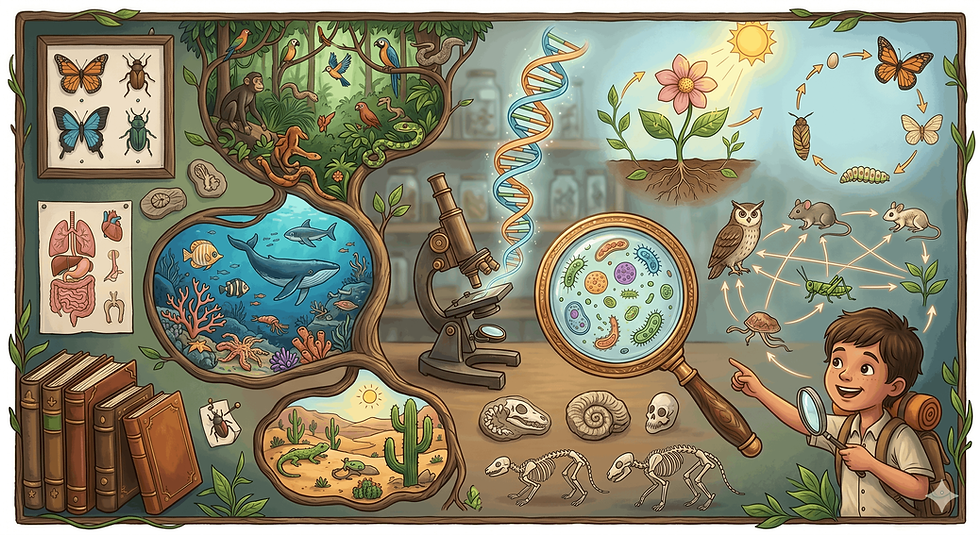
Emergency Sub Plans for Middle School Biology: Ready-to-Use Life Science Lessons

Every science teacher eventually needs an emergency sub plan.
Sometimes the absence is planned and you have time to prepare. Sometimes it is not. A lesson that was supposed to involve a practical cannot go ahead, the timetable changes, a piece of equipment is unavailable, or you simply wake up one morning knowing that you need a lesson another teacher can deliver without having to learn an entire biology unit overnight.
Biology can be particularly awkward for substitute teaching because so many science lessons depend on practical work, demonstrations, microscopes, models or teacher explanation. Those activities can be excellent when the regular teacher is present, but they are not always the best choice for an emergency lesson.
For middle school biology, I think the most dependable solution is to have a small bank of self-contained life science lessons ready to go. A good emergency biology lesson might use a reading passage, a few carefully designed questions, an anchor chart or graphic organizer, and, when more time is available, a structured research project.
The result is a lesson that can be taught by a substitute teacher with relatively little subject-specific preparation while still asking students to read, think, explain, use scientific vocabulary and apply biological knowledge.
The Teaching Astrophysicist Biology section currently covers a broad range of life science topics including cells, biochemistry, genetics and biotechnology, evolution, ecology, microorganisms, human biology, plants and environmental biology.

What makes a good emergency biology sub plan?
The first test is a simple one:
Could a substitute teacher hand this resource to students and get them started without having to teach the biology from scratch?
If the answer is yes, you probably have a useful sub resource.
A strong emergency biology lesson should have a clear purpose, straightforward instructions, student materials that make sense on their own and a definite end point. It should also ideally include teacher answers, guidance or some form of assessment so that the substitute teacher does not have to guess what students are supposed to have learned.
This is why I particularly like science reading passages for substitute teaching. A reading passage can provide the scientific content. Questions can make students retrieve and interpret information. A final critical-thinking question can ask them to use what they have learned rather than simply copying facts.
It also makes the same resource much more useful than a traditional emergency worksheet. The resource can be used when you are absent, but it can also become homework, a literacy activity, a review lesson, a lesson filler or an extension task.
My Free Science Resources collection currently contains a substantial selection of free middle and high school science materials, including biology resources.
Choose biology topics that do not depend on equipment
One of the most useful things you can do when building emergency sub plans is to separate your excellent normal lessons from your excellent emergency lessons.
A microscope investigation can be excellent science teaching. A dissection can be excellent science teaching. A practical on enzymes can be excellent science teaching. But they may not be ideal choices for a substitute teacher who has never used your equipment or taught the class before.
For emergency cover, I would favour topics that can be taught through reading, diagrams, information processing, research and written explanation.
Genetics is particularly useful. Evolution can work well. Ecology, adaptations, microorganisms, human biology, the brain, reproduction and aspects of health science can all be handled without specialist equipment. Even quite complex ideas can be taught effectively when the information is broken into a clear sequence.
That does not mean practical work is unimportant. Quite the opposite. It simply means your emergency folder should contain resources that still work when practical work is not an option.
The basic 45 to 60 minute emergency biology lesson
A very reliable emergency biology lesson can follow a simple structure.
Begin with five minutes of introduction. Students read the title, learning objective and instructions. They can make a quick prediction or answer one warm-up question about what they already know.
Give them around fifteen to twenty minutes to read the science passage.
Use another ten to fifteen minutes for comprehension, vocabulary and application questions.
Then use the last ten to fifteen minutes for a task that requires students to do something with the information.
That final stage is important. A substitute lesson should not become "read this and answer some questions." Ask students to explain a biological process, compare two ideas, identify evidence, make a connection to human health, interpret a piece of information or answer a question that requires some reasoning.
For example, students reading about the immune system could finish with:
Why is it useful for the immune system to distinguish between the body's own cells and foreign material?
Students reading about selective breeding might answer:
Why can selecting for one desirable trait sometimes produce unwanted consequences?
Students studying cellular respiration could explain:
Why does a muscle cell need a continuous supply of usable energy during exercise?
These are much more meaningful endings than simply asking students to define five terms.
Reading passages are ideal emergency biology resources
Science reading is particularly valuable for substitute teaching because it combines content learning with scientific literacy.
Students have to understand the language of science, extract relevant information and communicate their understanding. That is valuable whether the topic is genetics, ecology, cells or human biology.
My Is There a Fertility Crisis? Biology Reading Comprehension resource is a particularly good example of how this can work. It contains two versions of the reading, one more accessible and one more complex, with comprehension and critical-thinking questions.
The current product description specifically lists substitute teaching, extension and lesson filler among possible uses.
The two levels are also useful for mixed-ability classrooms. The accessible version is aimed approximately at grades 5 to 7, while the more advanced passage is aimed approximately at grades 8 to 10.
That means the substitute teacher can keep the whole class on broadly the same scientific topic without needing to create completely separate lessons.
There is a larger version of the same idea in the Human Fertility Crisis Biology Articles + Research Project Template Set. It combines differentiated reading passages with a longer research task, including a summary, mathematics connection, engineering or technology connection, glossary and inquiry questions. It can therefore work as a one-off lesson or as a longer piece of independent work.
Free biology resources can make a good starting point
You do not need to spend a fortune building an emergency biology folder.
Several of the current free resources in The Teaching Astrophysicist store are particularly suitable because they already provide a complete teaching sequence.
For example, the Cellular Respiration Infographics + Slides + Podcast + Quiz Biology Set is currently free and contains theory slides, a podcast, infographics and a question set. The product page specifically identifies substitute teaching, lesson filling, homework and independent study as possible uses.
This gives you several ways to run the lesson. The substitute teacher could use the slides to introduce the topic and then have students complete the questions. Students could work through the podcast independently if devices and headphones are available. The infographics could be used as a visual reference while students complete the written task.
Another useful free option is the Autoimmune Diseases Infographics + Slides + Podcast + Quiz Biology Set. It introduces the immune system, connects to cells, body systems, homeostasis, genetics and medical science, and includes slides, a podcast, infographics and questions. It is also explicitly listed as suitable for substitute teaching and lesson filler.
These are good examples of an important principle for emergency planning: a resource can be self-contained without being boring.
Students can still encounter a substantial biological idea, use proper scientific terminology and complete a meaningful task.
Insects are another easy emergency biology topic
I also like organisms and ecosystems as emergency lesson topics because there are plenty of interesting biological questions without needing equipment.
Insects are a particularly accessible example. Students can learn about anatomy, ecological roles, biodiversity, pollination, decomposition and relationships between organisms without needing a laboratory.
The current free science articles collection includes an Insects Biology / Life Science reading article, along with other free biology-related materials such as Asexual Reproduction and Animal Adaptations.
That gives you an easy way to build a simple middle school emergency lesson:
Students read about insects, answer the comprehension questions, identify important vocabulary and then explain why insects are so important to ecosystems.
It is real biology, but it does not require a microscope, live specimens or specialist preparation.
Anchor charts give students something to do with what they read
Reading is only part of the job.
Students also need to process what they have read.
This is where a science anchor chart or graphic organizer can be especially useful. Instead of asking students simply to answer six questions, you can ask them to organise the information into a structure.
They might identify the main idea and key details, organise a biological process as a sequence, compare two systems, identify cause and effect, or connect a scientific vocabulary word to an example.
My Science Reading Anchor Charts: Graphic Organizer, Main Idea and Key Details are well suited to this role. They can be paired with almost any biology reading passage, which is useful because your emergency folder does not need a separate graphic organizer for every individual topic.
This also helps avoid creating the kind of lesson where students read a page and then simply copy sentences from it.
For example, after reading about cellular respiration, students might make a simple flow structure showing how glucose and oxygen are involved in energy release. After reading about inheritance, they could organise the relationship between genes, alleles, traits and phenotype. After reading about ecosystems, they could map relationships between organisms and their environment.
The organizer should not exist just because every lesson needs a worksheet. It should help students structure biological thinking.
Research projects can turn an emergency lesson into a longer task
For a longer absence, a research project template can be extremely useful.
There is a big difference between telling students to "research genetics" and providing a structured research framework.
The first is vague. The second tells students what they need to produce.
My Genetic Pedigrees Biology Reading + Research + Worksheets Bundle is a good example.
It combines a science reading passage, a research project template and progressively more challenging worksheets. The research task includes a summary, mathematics connection, engineering or technology connection, scientific vocabulary, inquiry questions and a rubric.
That makes it far more manageable for independent work.
A substitute teacher can explain the sequence and then monitor students while they work. They do not need to invent the research questions or decide what a finished project should contain.
The same format can be useful in a wide range of biology topics.
My Spiders Biology Science Articles + Research Project Template Set combines a reading passage with a longer research task. Students can explore anatomy, silk, ecology and biomimicry, while the research template includes a summary, mathematics connection, engineering or technology connection, glossary and differentiated inquiry questions. The resource is also explicitly described as suitable for substitute teaching and longer running independent work.
This is a particularly useful pattern to have in your emergency folder because the same topic can fill one lesson or become a multi-lesson activity.
A good emergency lesson can become a longer lesson
One of my favourite approaches is to build a short version and a long version of the same lesson.
Imagine that your normal middle school biology class is studying the brain.
A short emergency lesson could use a reading passage and questions. Students learn about neurons, different parts of the brain and how the nervous system communicates information.
A longer lesson could add an infographic activity, a podcast and a research task.
My Neurobiology: The Brain Biology Focus Unit Bundle is a good example of this kind of flexibility. It currently combines theory slides, a podcast, infographics, assessment questions, two differentiated reading passages and a research project template. The product also specifically identifies substitute teaching and lesson filler as uses.
You do not necessarily need a six-resource bundle for every topic, of course. The principle is what matters.
A reading passage can be your 40-minute emergency lesson.
An anchor chart can extend it.
A research template can turn it into a second lesson.
An assessment or reflection can give you an additional ending.
That is much more efficient than building every emergency lesson from scratch.
Genetics is particularly useful for emergency cover
Genetics is one of the stronger areas for this kind of teaching because so much of the content can be explored through reading, diagrams, explanation and reasoning.
Students can work with inherited traits, pedigrees, selective breeding, genetic engineering, DNA, mutations and biotechnology without requiring a practical laboratory activity.
The Selective Breeding Biology Focus Unit Bundle is currently a good example of a broader topic sequence. It combines theory slides, an audio resource, infographics, assessment materials, a reading passage and a research project template.
That means you could use the reading passage by itself during a substitute lesson, introduce the topic with the visual material, or move into the research project if you know the absence is going to last for longer.
My Genetics section of the store also gives teachers a wider range of genetics resources rather than forcing every biology lesson into exactly the same format.
Choose the right biology topics for emergency teaching
If I were creating a middle school biology emergency folder, I would deliberately favour topics where students can make meaningful progress without practical equipment.
Cells are useful because diagrams, reading and explanations can do a lot of the teaching.
Genetics is useful because students can work with examples, inheritance patterns and evidence.
Ecology is useful because students can examine relationships between organisms, habitats and environmental change.
Animal adaptations work well because students can read, compare examples and explain why particular traits are advantageous.
Microorganisms can provide excellent reading and research opportunities.
Human biology and the brain can provide engaging independent learning because students can connect biological systems to familiar processes.
Selective breeding and biotechnology are useful because they combine biology with real-world applications and scientific reasoning.
My biology store is broad enough to support all of these areas, with dedicated categories for cells, genetics, evolution, ecology, microorganisms and human biology among others.
Topics I would not choose first for an emergency sub
There is nothing wrong with practical biology.
But I would not make the practical the centre of your emergency plan.
I would avoid leaving a substitute teacher instructions such as "Have students collect samples from around the school and culture bacteria," "Set up the enzyme experiment," or "Have groups use the microscopes to identify unknown specimens" unless you have very good reason to believe the substitute teacher can safely and confidently run those activities.
There are simply too many variables.
The same biological idea can often be taught in a safer and more reliable way during emergency cover. Students can read about enzyme activity and explain how temperature affects enzymes. They can analyse a table of experimental results. They can interpret a diagram. They can examine a case study.
Then, when the regular teacher returns, the practical can become the next step.
This creates a useful division between learning the biology and conducting the practical investigation.
A simple emergency biology folder system
I would keep the folder extremely easy to understand.
Have a section for quick lessons, another for longer independent projects and another for extension or early-finisher work.
For each lesson, include the student material, teacher answer version and a one-page instruction sheet for the substitute teacher.
That instruction sheet does not need to be elaborate. It should explain the topic, approximate timing, what students need to complete and what to do if students finish early.
It is also useful to write down anything the substitute teacher should not have to manage. If a particular digital activity needs a login, explain it. If printing is required, say how many pages. If students should submit digitally, make that clear.
The less interpretation required, the better.
Another useful idea is to make sure that every lesson has a natural stopping point. You do not want a substitute teacher discovering five minutes before the bell that the main activity is finished and there is nothing else for students to do.
This is another reason I like research project templates and differentiated resources. They give you natural extension activities.
Use differentiation without making the substitute teacher manage it
Mixed-ability classes are one of the hardest aspects of emergency teaching.
The regular teacher knows which students need extra support, which students need greater challenge and which students can work independently.
A substitute teacher may not.
That makes built-in differentiation extremely useful.
One way to do it is to provide two reading levels on the same topic. Another is to give everybody the same basic information but offer different inquiry questions. A third is to use an organizer that is more heavily scaffolded for some students and more open-ended for others.
My fertility crisis reading resource is a good example because students can work from a more accessible or more advanced passage while staying on the same overall biological topic.
The Fertility Crisis Research Project Template also contains differentiated inquiry questions, with an easier set for younger students and a more challenging set for older or more advanced students.
That kind of built-in differentiation is particularly helpful when the normal teacher is absent because the resource itself is carrying some of the differentiation workload.
Upper elementary biology and life science
Although middle school should be the main focus of an emergency biology resource bank, the same approach can be adapted quite easily for upper elementary.
The key change is the amount of structure.
Younger students will generally benefit from shorter texts, more explicit vocabulary support, simpler diagrams and more carefully sequenced questions.
Animal adaptations are a good example. Students could read a short passage about how animals survive in different environments, identify the main idea and key adaptations, complete an organizer and then explain one adaptation in their own words.
Asexual reproduction could work in a similar way. Students can learn the basic idea through a short reading task, identify examples and explain why producing offspring without a mate can be useful in certain environments. My free Asexual Reproduction materials provide another possible starting point.
The important thing is not to make the upper elementary version merely "the same worksheet with fewer words." The task itself should be designed for the amount of independence students at that age can reasonably manage.
High school biology and life science
At high school level, you can take the same emergency lesson structure and reduce the scaffolding while increasing the complexity.
A reading passage can ask students to evaluate evidence rather than simply retrieve information.
A research task can require students to compare sources.
An organizer can ask students to connect mechanisms rather than list facts.
A final written task can require a justified conclusion rather than a definition.
Genetics, human reproduction, neurobiology, biotechnology, evolution and health science lend themselves particularly well to this approach.
For example, a high school class could use a biology reading passage as the foundation and then investigate a question independently. They might examine evidence relating to human fertility, investigate a genetic disorder, explore how a medical technology works, or analyse a biological issue from several perspectives.
The Human Fertility Crisis Articles + Research Project Template Set is one example of a resource that can bridge middle and high school, with differentiated reading passages and a structured independent research task.
End the lesson with something students have to explain
I think this is one of the easiest ways to improve an emergency sub plan.
Do not let the lesson end with "finish the questions."
Give students something that requires them to explain what they now understand.
It could be a short paragraph.
It could be a Claim-Evidence-Reasoning response.
It could be a completed anchor chart.
It could be a labelled diagram.
It could be a short answer to a real-world question.
For example:
Why can selective breeding change a population over many generations?
How does cellular respiration help cells carry out their functions?
Why can an autoimmune disease cause problems even though the immune system is protecting the body?
How can an animal's adaptations increase its chances of survival?
The answer does not need to be enormous. What matters is that students have to use the biology they encountered during the lesson.
Build emergency sub plans before you need them
The real trick with emergency sub plans is to prepare them when you are not having an emergency.
Spend a little time building a folder during normal planning periods. Add one useful resource every few weeks.
You do not need thirty perfect emergency lessons immediately.
Start with five.
Have one cells lesson, one genetics lesson, one ecology lesson, one human biology lesson and one general life science reading lesson. Then gradually add more.
Over time, you will have enough material that an unexpected absence becomes a logistical problem rather than a lesson-planning crisis.
The good news is that many of these resources can be used well beyond emergency cover. Your reading passages can become regular literacy tasks. Your anchor charts can support normal lessons. Your research projects can become extension work. Your free resources can give you something useful when a lesson finishes early.
That is a much better investment than building a huge folder of worksheets that only ever gets opened when you are ill.
A practical example: the biology emergency lesson ladder
Imagine that you are absent tomorrow and your middle school biology class has recently been studying human biology.
A short lesson might use the free Autoimmune Diseases Biology Set. Students examine the introductory information, work through the questions and finish with a short explanation of how the immune system normally protects the body.
For a more literacy-focused lesson, you could use a reading passage and an anchor chart. Students read, identify key information, organise the science and complete a written response.
For a longer absence, you could move students into a research project. The teacher can provide the template, explain the expected sections and let students work through the task independently.
For a very capable class, you might add a debate, evidence-analysis activity or a longer written response.
The lesson therefore grows from the same basic idea:
learn the science, organise the science, use the science.
Emergency biology lessons should still feel like real science
The purpose of an emergency sub plan is not simply to keep students occupied.
It should give them something worthwhile to learn.
A student reading about cellular respiration, analysing information about selective breeding, investigating neurobiology, exploring animal adaptations or working through a genetics research project is still doing science even when the regular teacher is not in the room.
That is why I think the combination of reading passages, questions, anchor charts, research templates and structured independent work works so well for emergency biology teaching.
A reading passage provides the scientific content.
Questions check understanding and make students process the information.
An anchor chart helps students organise what they have learned.
A research template provides a longer route into a topic.
A final explanation demonstrates whether the student can actually use the biology.
The Biology section of The Teaching Astrophysicist has resources across cells, genetics, evolution, ecology, microorganisms, human biology, plants and environmental biology, while the Free Resources section provides a growing selection that teachers can use without purchasing anything first.
For teachers who want to explore a particularly complete example, the Neurobiology: The Brain Focus Unit shows how reading, visual resources, assessment and research can work together in one topic.
And for a simpler starting point, the free Cellular Respiration and Autoimmune Diseases resources are both already structured around independent learning and are explicitly identified as suitable for substitute teaching.
A good emergency lesson should not feel like a consolation prize because the normal teacher is absent.
It should feel like a lesson you would be happy to teach yourself.
Thanks for reading
Cheers and stay curious
Oliver - The Teaching Astrophysicist