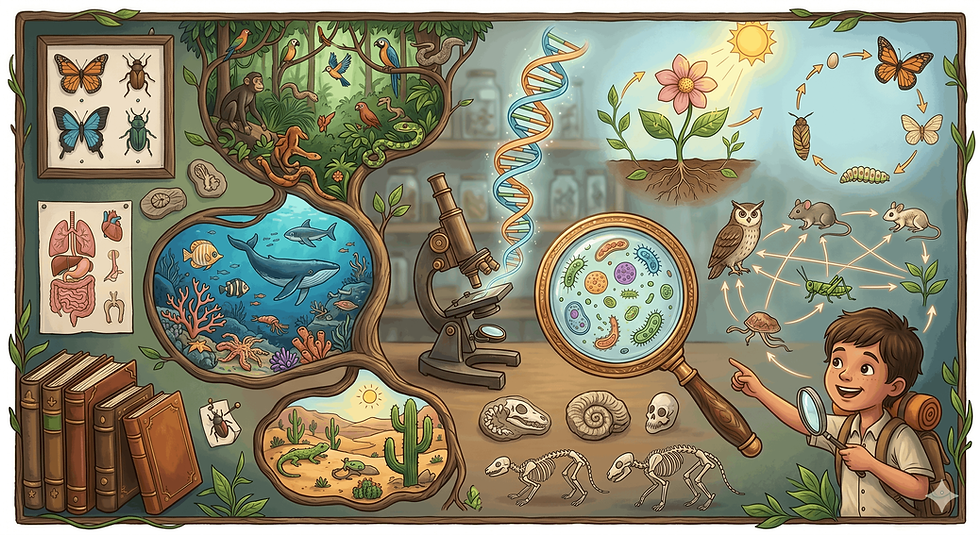
High School Biology Vocabulary Words: The Ultimate Life Science Spelling and Vocabulary Guide for Scientific Literacy

Biology is the study of life, and it serves as one of the most important sciences students encounter during high school. From molecular genetics and cellular processes to ecosystems and evolution, biology introduces learners to a sophisticated scientific language that allows them to understand living systems at every scale.
One of the greatest predictors of success in biology is vocabulary knowledge. Students who understand scientific terminology are better equipped to read scientific texts, interpret data, engage in classroom discussions, write laboratory reports, and analyze complex biological concepts. Strong vocabulary skills also help prepare students for advanced coursework in biology, environmental science, medicine, biotechnology, nursing, and other STEM-related fields.
This guide provides a comprehensive collection of high school biology vocabulary words, practical teaching strategies, and ideas for developing scientific literacy through reading passages and vocabulary-rich learning experiences.

Why Biology Vocabulary Is So Important
Scientific vocabulary acts as the language of biology.
Students with strong biology vocabulary are more likely to:
Understand complex scientific texts.
Improve reading comprehension.
Communicate scientific ideas accurately.
Analyze biological processes.
Perform better on assessments.
Interpret graphs and data.
Prepare for college-level science courses.
Because biology contains thousands of specialized terms, consistent vocabulary development should be embedded throughout instruction rather than treated as a separate activity.
Cell Biology Vocabulary
Cells are the fundamental units of life and introduce students to many essential scientific terms.
Cell Structure Vocabulary
Cell
Organelle
Nucleus
Cytoplasm
Cell Membrane
Cell Wall
Ribosome
Mitochondrion
Chloroplast
Vacuole
Lysosome
Endoplasmic Reticulum
Golgi Apparatus
Cytoskeleton
Vesicle
Cellular Processes Vocabulary
Diffusion
Osmosis
Active Transport
Passive Transport
Homeostasis
Photosynthesis
Cellular Respiration
Fermentation
ATP
Metabolism
These concepts form the foundation for understanding biological systems.
Genetics Vocabulary
Genetics is often one of the most challenging and vocabulary-rich units in biology.
Genetics and Heredity Terms
DNA
RNA
Gene
Allele
Chromosome
Genome
Trait
Heredity
Mutation
Inheritance
Dominant
Recessive
Genotype
Phenotype
Codominance
Incomplete Dominance
Polygenic Trait
Genetic Engineering
Biotechnology
CRISPR
These terms help students understand how traits are passed between generations.
Molecular Biology Vocabulary
Modern biology increasingly focuses on molecular processes.
Molecular Biology Terms
Protein
Enzyme
Amino Acid
Nucleotide
Lipid
Carbohydrate
Monomer
Polymer
Transcription
Translation
Replication
Codon
Anticodon
Messenger RNA
Transfer RNA
Understanding these words helps students connect chemistry and biology.
Evolution Vocabulary
Evolution provides a framework for understanding life's diversity.
Evolutionary Biology Terms
Evolution
Natural Selection
Adaptation
Fitness
Speciation
Common Ancestor
Fossil
Extinction
Variation
Selection Pressure
Genetic Drift
Gene Flow
Mutation
Phylogeny
These concepts help explain biological change over time.
Ecology Vocabulary
Ecology examines interactions between organisms and their environments.
Ecology Terms
Ecosystem
Habitat
Niche
Population
Community
Biodiversity
Biome
Food Web
Food Chain
Trophic Level
Producer
Consumer
Decomposer
Carrying Capacity
Limiting Factor
Symbiosis
Mutualism
Commensalism
Parasitism
Ecology vocabulary helps students understand environmental systems.
Human Body Systems Vocabulary
Many biology courses include anatomy and physiology.
Anatomy and Physiology Terms
Tissue
Organ
Organ System
Homeostasis
Neuron
Hormone
Enzyme
Immune Response
Circulatory System
Respiratory System
Digestive System
Nervous System
Endocrine System
Muscular System
Skeletal System
These terms support understanding of human health and medicine.
Microbiology Vocabulary
Microbiology introduces students to organisms invisible to the naked eye.
Microbiology Terms
Bacteria
Archaea
Virus
Fungus
Protist
Pathogen
Parasite
Antibiotic
Vaccine
Immunity
Infection
Disease
Microorganism
Students often find these topics highly engaging because of their real-world relevance.
Plant Biology Vocabulary
Plant science remains an important component of biology.
Botany Terms
Chlorophyll
Photosynthesis
Stomata
Xylem
Phloem
Germination
Pollination
Fertilization
Angiosperm
Gymnosperm
Tropism
Transpiration
These concepts connect biology with agriculture and ecology.
Advanced Biology Vocabulary for High School Students
Students pursuing honors, AP, IB, or advanced biology courses may encounter:
Epigenetics
Biotechnology
Bioinformatics
Proteomics
Genomics
Recombinant DNA
Electrophoresis
Homeostasis
Signal Transduction
Apoptosis
Endosymbiosis
Phylogenetics
Biodiversity
Ecological Succession
Carrying Capacity
Cellular Differentiation
Stem Cell
Gene Expression
Genetic Drift
Horizontal Gene Transfer
Mastering these terms helps students prepare for university-level science.
Commonly Misspelled Biology Words
Many biology terms contain challenging spelling patterns.
Provide extra practice with:
Photosynthesis
Mitochondrion
Chromosome
Biotechnology
Microorganism
Endoplasmic
Respiration
Homeostasis
Biodiversity
Electrophoresis
Differentiation
Evolutionary
Pollination
Transpiration
Phylogenetics
Frequent exposure through reading and writing improves spelling accuracy.
The Best Way to Teach Biology Vocabulary
Vocabulary develops most effectively when students encounter words repeatedly within meaningful contexts.
Science Reading Passages
Reading passages provide one of the most effective ways to introduce and reinforce scientific terminology.
Students may encounter:
"Natural selection" while reading about evolution.
"Homeostasis" while studying human physiology.
"Mutation" while learning genetics.
"Biodiversity" while exploring ecosystems.
Context-based learning promotes deeper understanding than memorization alone.
Vocabulary Journals
Students can:
Record definitions.
Create diagrams.
Write examples.
Draw concept maps.
Connect vocabulary to laboratory investigations.
Scientific Writing
Writing explanations, summaries, and laboratory reports helps students actively use scientific language.
Discussion and Debate
Using biology vocabulary during classroom discussions reinforces long-term retention.
Using Reading Passages to Build Biology Vocabulary
One of the most effective ways to strengthen scientific literacy is through high-quality science reading passages.
Reading passages help students simultaneously develop:
Reading comprehension
Scientific literacy
Academic vocabulary
Critical thinking
Background knowledge
Scientific communication skills
Teachers looking for ready-to-use science literacy resources can explore the extensive collection of science reading passages available here:
These resources cover a wide range of biology topics including genetics, cells, evolution, ecosystems, microorganisms, anatomy, physiology, biotechnology, and environmental science. Students naturally encounter advanced scientific vocabulary while improving comprehension and analytical thinking.
Additional science resources can be found at:
Many educators find that combining vocabulary instruction with engaging reading passages provides one of the most effective methods for improving both literacy and scientific understanding.
A Weekly Biology Vocabulary Routine
Monday
Introduce 10–15 target biology terms.
Tuesday
Read a biology passage containing the vocabulary.
Wednesday
Complete comprehension and discussion activities.
Thursday
Apply vocabulary through investigations, diagrams, or research.
Friday
Use scientific terminology in writing assignments, quizzes, or presentations.
Consistent exposure is the key to long-term mastery.
Final Thoughts
Biology vocabulary provides students with the language needed to understand life at the cellular, organismal, and ecosystem levels.
By integrating vocabulary instruction with reading, writing, discussion, and inquiry-based learning, teachers can help students become stronger readers, more confident communicators, and more scientifically literate learners.
Whether students are studying genetics, evolution, microbiology, ecology, biotechnology, or human physiology, a strong biology vocabulary foundation supports academic success and prepares them for future STEM opportunities.
Thanks for reading
Cheers and stay curious
Oliver - The Teaching Astrophysicist